From October 2026, we’re asking hosting providers seeking verification in our dataset to share a statement showing their commitment to reaching a fossil-free internet. In this post, Fershad Irani, our verification manager, shares how providers can get started with this and presents our own statement.
As part of the changes planned for our verification criteria, which take effect on October 1, 2026, we are asking hosting providers to share a simple statement that publicly demonstrates their commitment to reaching a fossil-free internet.
In our documentation we call it a 2030 Fossil-free Statement, but in reality the date is less important than the fact that the statement is public. Public transparency makes these statements a means to observe companies’ continued commitment to a fossil-free transition. They also provide something meaningful and predictable for customers to look for when assessing hosting provider choices.
What should a fossil-free statement contain?
Sharing a fossil-free statement is an optional part of the verification process. We know that some providers already have a statement in some form, and we hope that making this part of our verification process will encourage others to take that step too.
When it comes to what a fossil-free statement should contain, we ask providers to cover the core themes listed below:
- A time-based commitment to using 100% hourly matched fossil-free (carbon-free) energy for their hosting infrastructure.
- A pointer to the standards, guidelines, or criteria the provider is following to disclose their claims.
- An endorsement of the statement from a member of the organisation.
- The date the statement was endorsed, and the time it will next be reviewed.
- A way for people to contact the organisation for more information.
To help organisations get started, we’ve published a template of a sample fossil-free statement.
Where should a fossil-free statement be published?
You can publish your fossil-free statement as a standalone web page, or include it in your organisation’s existing sustainability and corporate reports. It should live at a public URL which ideally remains the same over time.
Here is an example of a commitment from Google, which is in a PDF format at https://sustainability.google/reports/247-carbon-free-energy/. Below, we share another example of our own fossil-free statement, which we have published as a regular old web page.
Our own 2030 fossil-free statement
We are not a hosting provider ourselves but, as an organisation, we really care about meaningfully decarbonising the energy used to power the digital infrastructure we use. So with that in mind, we’ve published our own 2030 fossil-free statement. Our statement demonstrates our commitment to a fossil-free internet by 2030, as well as the progress our hosting suppliers are making towards that goal.
View Our commitment to a fossil-free internet by 2030
Showing progress in our fossil-free statement
Our 2030 statement largely follows the template we have shared earlier. However, we have extended it to include information about the ‘upstream’ digital suppliers we use, and how they are progressing towards decarbonising the energy they use to power the services we rely on.
We want to represent the progress our suppliers are making in a way which shows progress, is repeatable, and incentivises meaningful decarbonisation. That last part is important, and ties in with the future-facing direction we see carbon-free disclosures heading – towards granular, hourly-matched disclosures. To do this, we use three “tiers” to categorise where our digital services run.
- Tier 0: A tier 0 region is one where a supplier is not making any disclosures about using carbon-free energy. They are not actively buying clean energy to decarbonise their operations.
- Tier 1: A tier 1 region is one where a supplier makes annually matched disclosures about buying carbon-free energy. They may be 100% annually matched, but generally, there are still hours in the year where the infrastructure ends up running on electricity from fossil fuels, without matching clean generation. We cannot achieve 100% carbon-free energy use in this way.
- Tier 2: A tier 2 region is one where a supplier makes hourly matched disclosures about buying carbon-free energy, usually using a combination of different clean energy technologies, to avoid relying on fossil generation. We can reach 100% carbon-free energy use in this way.
This framework, then allows us to better assess how far our suppliers help us get to our end goal, and give them a score which represents their progress towards decarbonising the energy they use. Getting the average of the scores for all our providers also allows us to reach an overall score for our organisation.
Our own numbers
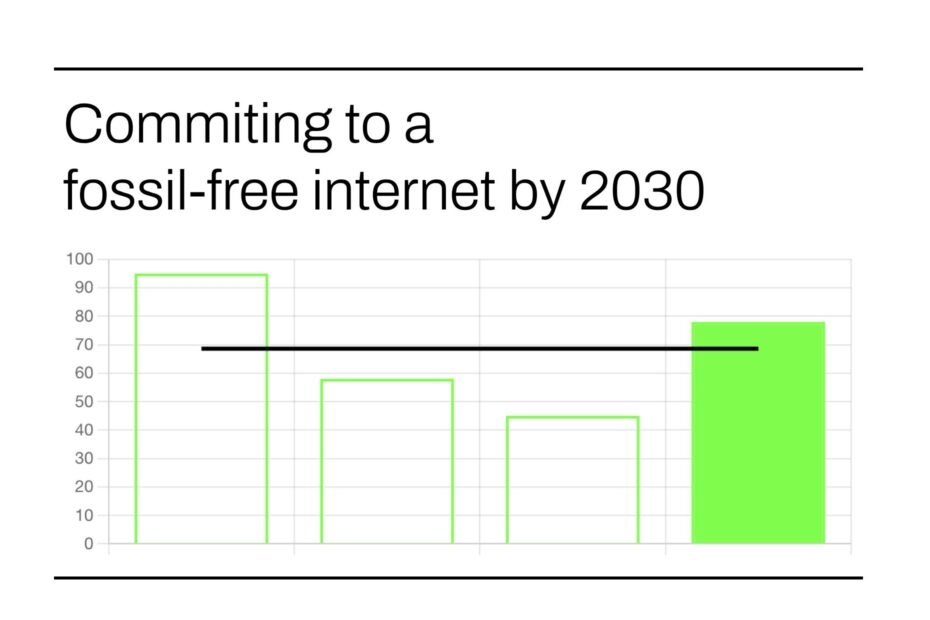
For our organisation, we are currently at 67% progress to being completely hourly matched with renewable energy. In the table below, you can see each of the suppliers we use and their individual progress, as well as the result for our organisation. Across all our suppliers, we have three (3) who make annually matched claims for fossil-free energy use, and one (1) supplier who’s disclosures point to hourly matched disclosures.
| Region | Disclosure tier | Fossil-free energy | |
|---|---|---|---|
| Hetzner | Finland | Tier 1 | 95% |
| 34SP | England | Tier 2 | 78% |
| Scaleway | Netherlands | Tier 1 | 58% |
| Cloudflare | Global | Tier 1 | 45% |
| Overall Score | 67% |
These numbers (both for our organisation and individual providers) can be tracked over time, and we want to be seeing them get as close to 100% as possible – indicating that 100% hourly-matched energy decarbonisation has been achieved. From our perspective, we know it won’t be easy, but we are committed to increasing our own overall progress score each year to 2030.
This uses the same data as is required for reporting that uses the GHG Protocol, or for the new Science Based Targets Institute V2 corporate standard, but we present it this way to help understand what next actions get us closer to our goal of 100% by 2030.
Going into detail about how the framework calculates scores is out of the scope of this blog post. To learn more about that, we recommend reading this blog post by Fershad and going through this slide deck from Chris.
Need to find similar information about your digital suppliers?
We can help you understand how the digital service providers you use are making progress towards decarbonising their infrastructure. Get in touch.
Create and publish your own fossil-free statement
Being committed to a fossil-free internet isn’t just something providers of hosting infrastructure should care about. Every organisation can, and should, commit to decarbonising the energy they use for digital and other services. These statements have the power to shape conversations with and decisions about the digital suppliers those organisations use.