Over the last few months, we’ve been working on a project we’re calling DIST (Digital Impacts Schema and Taxonomy) – an open source project to provide standards-aligned guidance to categorise, structure and report your organisation’s digital technology sustainability data. In this post, Director of Technology and Policy Chris Adams gives the gist on DIST.
We talk a lot about the environmental impacts of digital services at the Green Web Foundation – and we know first hand how difficult getting reliable numbers together if you want to understand them, you want to actively manage them, or even just to report on them.
In addition, it’s rare to for people to a have a deep understanding of sustainability or environmental management AND a deep understanding of technology, and it’s even rarer for knowing both to be someone’s full time job in a company.
So in times like this, it’s helpful to have guidance available on what to you might need to report, and how people calculate these impacts, so if you’re tasked with working out these numbers, you’re not starting from scratch, but benefiting from some curation of calculation methods, and from someone structuring the data you might report in standardised ways. These are some of the key ideas behind DIST.
What is DIST?
DIST, short for Digital Impacts Schema and Taxonomy, is an integrated suite of three open-source tools we’ve been developing to support assessment and reporting of your organisation’s digital technology environmental impacts.
We have a Taxonomy, a Methodology Map, and a Schema, which are designed to work together.
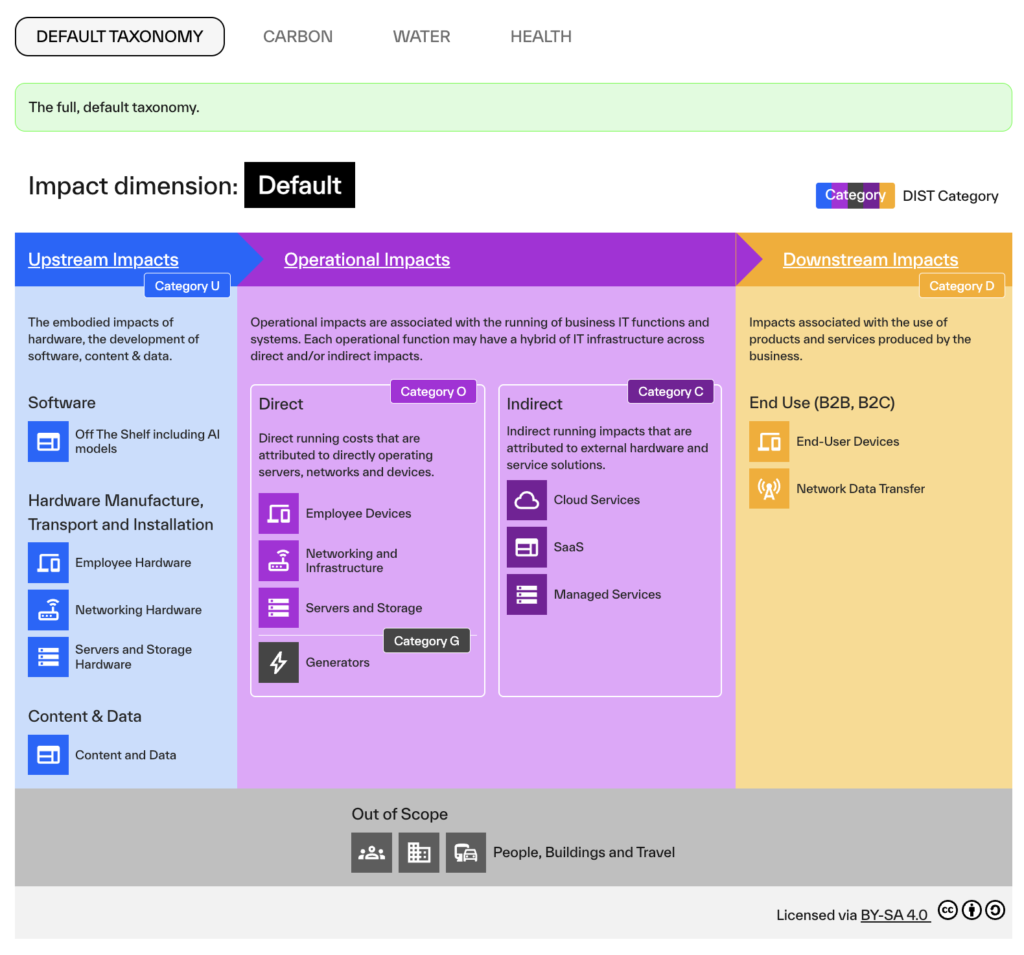
The Taxonomy is a standardised categorisation system covering digital’s full lifecycle and compatible across multiple impact dimensions. This is here to help ensure nothing important is missed, and where they might typically show up in common types of reporting.
Once you have an idea of what kinds of impact to look out for, the Methodology Map acts as a curated list of available measurement and estimation methods across all categories of the taxonomy. This gives you an idea of which approaches, tooling, data, and software models you can use to get the numbers you need.
Finally, the Schema is structured data format for sharing your quantified impact numbers. This is provides transparency about your scope and measurement approaches.
What can I do with DIST?
Right now, you can use DIST to help structure the data you collect and report, and you can use our methodology map to see common ways people work out the environmental impacts of different digital services or hardware.
See what you might be missing in your reporting if you have started already. Get a headstart if you haven’t
Visit our taxonomy page on the DIST website to see an interactive tool to develop a shared understanding of what to collect. See our corresponding category pages with further guidance for each section.
See how people calculate impacts
If you visit the DIST website, and our methodology map page, you’ll see a curated list of software, methodologies and models used for making calculations.
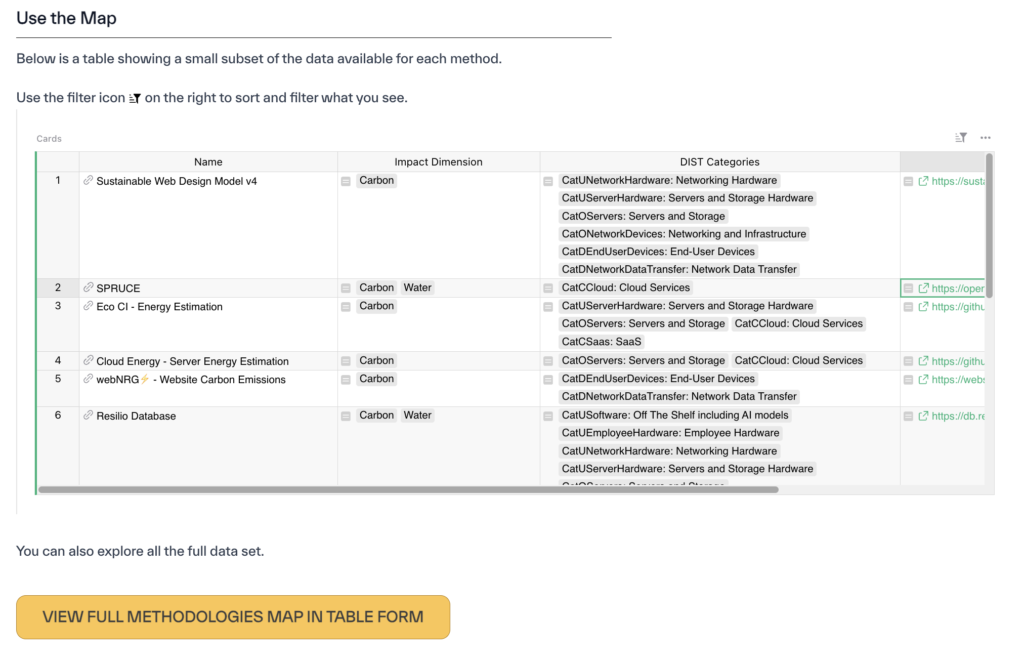
We have a curated short list so far, that you can browse and filter, based on what kinds of impacts you want to calcute and report. We’re actively looking for more submissions, so if you see a gap that something you’re working can close, we’d love to hear from you – see our contribute a methodology page for more.
Disclose impacts in a structured, standardised way
If you already have some numbers, you can use our schema to make it clearer how you arrived at them, for other people (and machines) to read in a vendor neutral, open format.
If you build software to help people estimate the environmental impacts of digital services or hardware, use the schema to make your output easier to use in the aggregated disclosures your customers need to make, when reporting across their full digital estate. See our tutorial for generating your first structured output, and see an example of a completed DIST.json file we created for an earlier piece of our own reporting on the impacts of our digital estate.
Learn more at our workshop at Green IO in London
DIST is an open source project, and you are free to use it in your own work. One of our fellow travellers, Oliver Cronk of Cronk Advisory is running a workshop on DIST at the Digital Sustainability conference Green IO in London later in September.
We are running DIST as an open project because we want to grow an interoperable ecosystem of professionals and agencies using it in commercial products and services.
If you’re able to attend, this workshop is one of the best places to speak to others using it. Otherwise if you still want to learn more, see how you get can involved on the DIST website. We run weekly calls you can join, and we collaborate on Github.
Get commercial support using DIST on your projects
Finally, if you’re already working on a project where you think DIST might be useful, and you might want some help on a commercial basis, we’re happy to have an informal, no-obligation call to understand your needs, and where we can help. Drop us a line to enquire about our commercial services.