Version 0.6 of carbon.txt includes several improvements frequently requested by members of the carbon.txt community, including support for certification schemes, measurement data, and disclosure descriptions. In this post, Tim, our carbon.txt developer, takes you through the latest changes.
Certification schemes
This is one of the more ambitious sets of new features we’ve shipped. Let’s step through what we mean by the term “certification scheme”, why we think it’ll be helpful and what’s included in this release.
What is a certification scheme?
We use the term “certification scheme” to refer to any independent third party organization which does two things:
- Sets out voluntary standards on sustainability, energy use, or emissions commitments,
- Audits or verifies an organization’s adherence to those standards.
A good example is something like B Corp, which both sets out the B Lab Standards for social environmental and governance practices, and also certifies companies for compliance with them. In the tech industry specifically, schemes such as TCO certified cloud specify criteria for best-practices around low impact online services, and independently verify compliance with them.
Why is this useful inside carbon.txt?
We believe that certification schemes are an important feature in carbon.txt for two reasons.
Firstly, surfacing an organization’s certifications in a clear, unambiguous way creates more clarity about the credibility of an organization’s sustainability claims. For instance, it’s one thing to see disclosure documents showing that a company’s data centres run on 100% renewable energy, and quite another to know that’s the result of a deliberate programme of carbon emissions reduction which has been independently audited.
Through tying disclosures to certification schemes, users of carbon.txt have more ways to understand how disclosure documents relate to specific sustainability standards. This is increasingly critical in the EU as the new EmpCo legislation has recently come into force.
Secondly, by supporting certification schemes in carbon.txt, certifying organizations themselves can use carbon.txt to more easily access the evidence they need to certify an organization. For instance, an organization seeking a certification could publish all the evidence required by the certifiers in their carbon.txt file, ensuring that the certifier can more quickly and easily verify their compliance.
It’s worth noting that the certification schemes support is entirely optional: you can continue to use carbon.txt to publicise your disclosures without referring to specific certifications, and all the existing syntax remains valid in the new version!
How does this work in practice?
In a nutshell, we’ve introduced a new section for listing any relevant certification schemes your organization adheres to. Then in the disclosures section you can link specific documents to that certification, such as the scheme certificate or other supporting information, creating more context about what each document relates to.
The certification schemes syntax looks like this:
[org]
certification_schemes = [
	{ id = "blauer-engel",
    url = "https://www.blauer-engel.de/en/productworld/software",
    title = "Blauer Engel Resource and Energy-Efficient Software Products",
    description = "The aim of the environmental label for resource and energy-efficient software products is to reduce the total energy consumed by information and communication technology and improve resource efficiency."
  },
]
Each certification scheme must at a minimum include a URL for the certifying organization, and an ID: this is an alphanumeric identifier which can be anything you choose, as long as it’s unique to this certification within this file. The ID is what we use to link disclosures to a particular certification. The full syntax for v0.6 is available on our website.
In addition, you can optionally include a human-readable title for the scheme, and a longer prose description: providing details of the specific commitments or policies it entails, or details of your organization’s adoption of it.
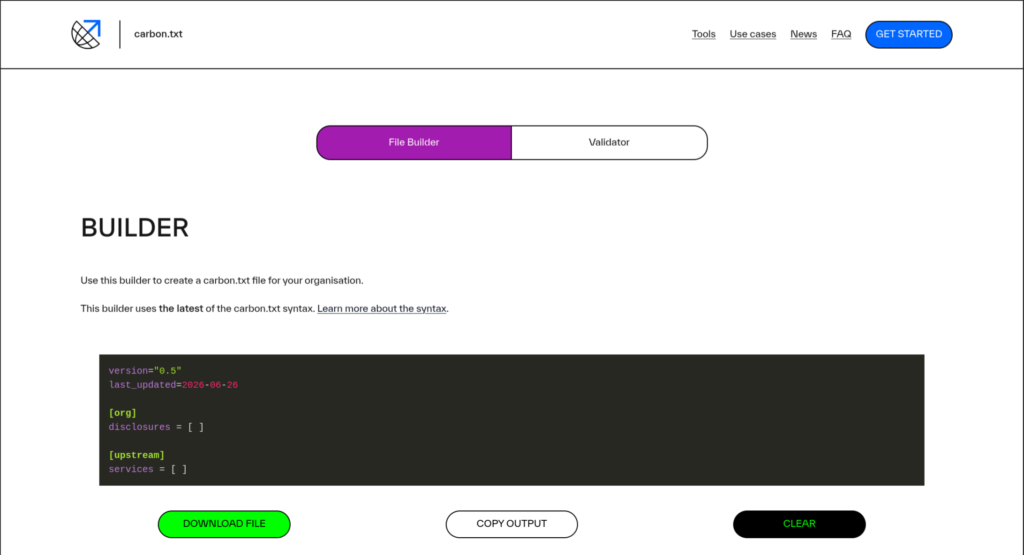
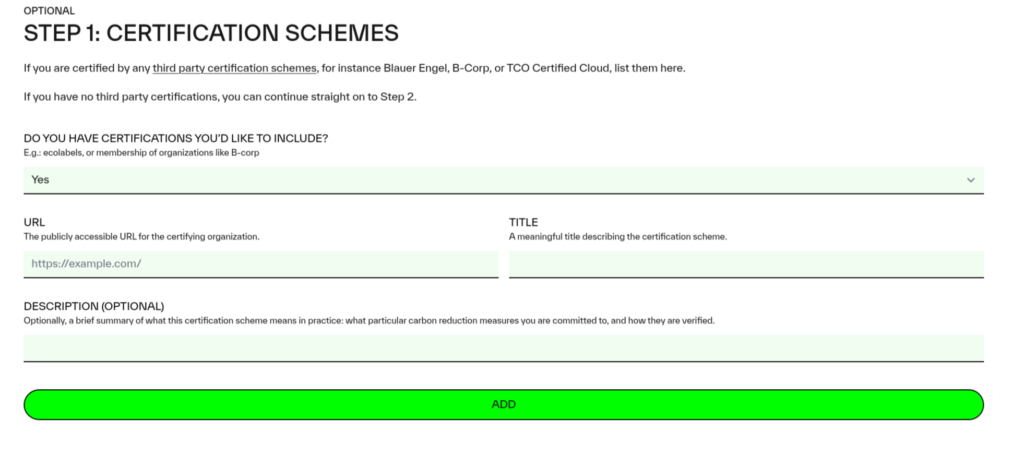
If you use our freely available builder tool, it will take care of creating the ID for you, so you just need to provide the url and title of your certification.
Once you’ve defined your certification schemes, the next step is to link individual disclosures (e.g. particular documents) to a scheme, using the new certification_schemes property.
{ doc_type = "sustainability-page", url = "https://mycompany.com/sustainability", domain = "mycompany.com", certification_schemes=["blauer-engel"], description="This company's sustainability policy." },
The certification_schemes property takes the certification scheme IDs we defined above, establishing a link between a disclosure and the certification schemes it is relevant to. You can list one or more IDs per disclosure line.
What sort of disclosures might be relevant to certification schemes?
A disclosure is simply a publicly available document that you already host online and that you point to from a carbon.txt file. It could be a web page, .pdf file or other online document.
Disclosures could be relevant to a certification scheme for a couple of different reasons.
Firstly, it might be considered pertinent evidence for that certification. For instance, an auditor for the Blauer Engel energy-efficient software products certification would want to see empirical data around the energy and resource usage of a software product, which could be included in a disclosure.
Secondly, a disclosure might reflect the certification itself: it could be a certificate awarded by the certifying organization which recognises and validates an organization’s compliance.
Finally, a disclosure might be a product of a certification, something produced as a result of the specific commitments required by the certifying organization. For instance, the B Corporation standards require organizations to produce yearly impact reports while certified, which could be included as disclosures in carbon.txt.
Try out our builder tool to get started
If you want to explore how to use the certification schemes support in your own organization’s carbon.txt file, our freely available builder tool helps you create a valid file quickly and easily.
Measurement data document type
Moving on to another change in version 0.6 of carbon.txt – we’ve also added “measurement-data” as an accepted doc_type in the disclosures section of carbon.txt’s syntax.

This allows more clarity around one of the more frequently added types of disclosure we’ve seen: documents which provide details of empirical measurement or quantitative estimates of carbon emissions, energy use, and other impacts.
One of the guiding principles behind the development of carbon.txt has been to surface more standardised machine-readable formats holding sustainability data. One such example is the recently published DIST schema, a sister project of Green Web Foundation.
Disclosure details
Finally, a small, but important update in v0.6 which has been requested by the community: providing a way to include a short description for disclosures: “description” has been introduced as a new property of a disclosure.

Our community have indicated this will be particularly useful for long documents, like annual reports, where the majority of the content might not be relevant to an organization’s environmental impact. You can use the description field to mention the relevant sections or provide more context.
Thank yous and acknowledgements
We’ve been working on our certification schemes support in collaboration with the broader community of carbon.txt users and implementers, and are really happy with how that process has worked out. Thanks in particular to Siddhesh Wagle of SystemsTree, Tim Frick from Mightybytes, and Owen Rogers of bigroom.eco for their valuable insight and feedback!
We’re keen to encourage more carbon.txt stakeholders to participate in shaping the future of the standard, so please do leave us feedback, bug reports and feature requests, and participate in existing discussions in our github issues!
Get help to implement carbon.txt in your project
If you’re working on a project, and you’d like help implementing carbon.txt in your work, or if you’d like to contribute to the further development of the standard, please feel free to raise a github issue! . We also offer commercial support on integration, as documented in existing case studies. Drop us a line for a free no-obligation call for advice.