Just last week, the Spanish government wrote into law what is now commonly referred to as the “Datacentre Decree”, and if you care about a fossil free internet, it’s a pretty big deal. In the midst of a global mania to build new, hyperscale datacentres, this is the first law in Europe that, while far from perfect, has the first meaningful requirements on powering these massive structures with clean energy. Our director of policy Chris Adams takes us through its implications, and what might happen next.
Some background: Spain as a microcosm of the datacentre build out debate
Last year in September we took part in a consultation about the Spanish Datacentre Decree when it was being referred to as the “Ley CPD” – a law being drafted in response to a dramatic influx in datacentre companies wanting to build new facilities in the country.
What do we mean by ‘dramatic influx’ though? Right now, in 2026, some of the best open estimates and modelling say that around 700 megawatts (MW) of datacentre IT capacity exists across the country. While 700MW is less than what you see operating in other large economies like Germany, France and the UK, the rates of change matter.
Like many places, this is expected to change quickly, and have far reaching changes.
Growing fast
If we look at the queue of datacentres that have been granted permits for accessing the grid in the coming years, we see more than twenty times that 700MW figure – 15 Gigawatts (GW) announced by the Spanish minister for Ecological Transition. In addition, coming behind that is a further 20 GW waiting for connection. So together, that’s 35 GW – a fifty fold increase.
Community pushback
If you only look at energy demand, increasing the energy consumption of anything by 50 times so quickly obviously has implications if you care about a fossil free internet (does the power come from?).
But let’s be honest; you shouldn’t just look at the energy and all infrastructure has at least some unavoidable environmental impact.
There are myriad issues related to a buildout like this, like the local impacts of communities, the impact of non-carbon impacts like water availability, air quality, and so on. There are also distributional and governance issues – where benefits accrue, who gets to decide when and how structures like this show up.
So faced with what could be a 50 fold increase in less than a decade, it’s unsurprising that local communities in drought-stricken areas, already concerned about lax regulation might rightly push back against these changes.
This is the political climate that led to this new datacentre Decree..
What the new decree asked for
At least partly in response to calls to regulate, the new Spanish Decree has been working through the legislative process, and came into effect last week.
What was it asking for?
This is a long law, and covers a lot of things, like introducing meaningful minimum efficiency and water usage standards, and in early drafts ruled out non European ownership and operation of datacentres as well. The Spanish non profit group Tu Nube Seca Mi Rio (Your Cloud Dries My River), have a helpful english post summarising the development of the law – it’s worth a read for a fuller picture.
Given we talk about a fossil free internet a lot here, we’ll focus on that, as what was required is worth our attention.
Meaningful fossil-free electricity – the closest we’ve seen to “near, near, and now” principles we call for
A key thing the new Datacentre decree required was that every datacentre, as a condition of being allowed to connect to the grid at all, before it can draw any power would need to demonstrate that it had procured enough new renewable electricity generation to make sure that all through the year, every hour of the year, at least 80% of the electricity powering the datacentres would come from renewable sources.
This needs to be unpacked in detail, because this law is in some ways more ambitious than it first sounds, and it comes down to a the way the hourly matching is worded.
When 80% is better than 100%, and really more like 99%
First of all, this law is looking at hourly matching of supply to demand, not annual matching. We’ve spoken at length about why annual matching is problematic, but in short, matching 100% of supply to demand on an annual basis is much easier to achieve than doing the same on an hourly basis, but also much less credible.
Secondly, this is a minimum for every hour, not an hourly average over the year. This is different to the common approach you see when people talk about hourly matching of supply to demand. When you are looking at the hourly average, there can be some hours where you might dip below 80% hourly matching, as long as over the year the average for each hour is 80%.
We appreciate this is quite a lot of detail, so thankfully, we can refer to work by friends of the Green Web Foundation Iegor Ripin of PyPSA Labs and Killian Daly of Energy Tag for took the time to model the impact of the law, to help make this easier to understand, using open source energy modelling tools, freely accessible data, and clear, traceable provenance of every single number used. You can see the full analysis on Github, and reproduce any numbers yourself.
From the analysis is a helpful bar chart below to explain why this Decree is more ambitious on clean energy than it first appears.
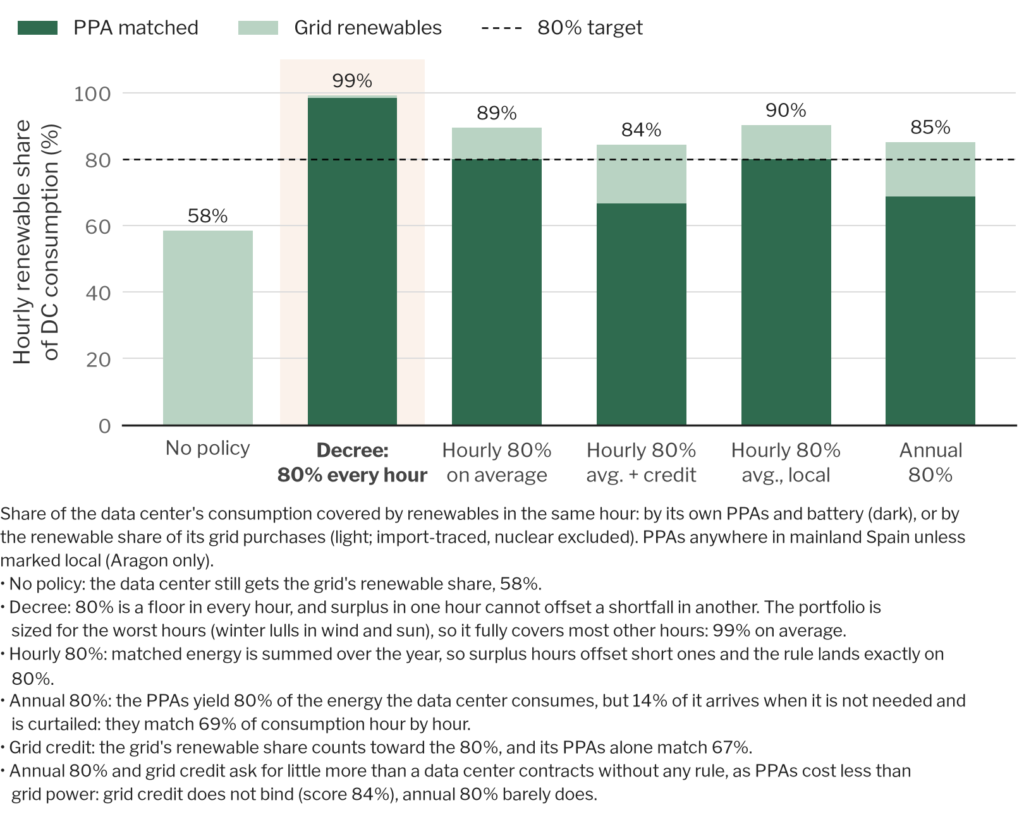
What are we looking at here?
The bar on the far left shows what would happen with no policy. The gap between the light bar and the dotted line represents power from the grid that would come from fossil generation – things like burning gas.
Spain’s electricity prices are generally lower than other parts of Europe, primarily because they do not rely on gas as much as their neighbours. Increasing the amount of gas used makes things more expensive for everyone, and is also bad news from an environmental perspective.
The second bar from the left in the chart below shows us that if you meet an 80% floor on hourly matching, like the law says, you’re actually closer to a 99% percent hourly matching score the way it is more commonly calculated.
This would be as close to true fossil free power as we have seen written into law anywhere in the world.
Finally, the bar on the far right also shows the problem with an 80% annual matching. See how the dark green bar ends up below the dotted line, and is topped up by the light green one?
That’s showing how datacentres end up using clean power already in the grid, that would otherwise go towards decarbonising the rest of the Spanish economy, rather than meeting new demand from new datacentres. This may be good for datacentres, but not so good for everyone else. There are many reasons why annual matching is being seen as less and less credible over time, and this is one of them.
Who pays to bring datacentres onto the grid?
The other impact of this law was related to this clean energy requirement, because it also has implications for the price of electricity for everyone else in Spain too.
In short, because planned datacentres represent such a massive new quantity of electricity being consumed, and because datacentres normally do not flex the power they consume, with no policy intervention, they are expected to end up changing how power gets generated in Spain to meet their demand.
We can refer to the modelling here to make sense of that as well, which backs the chart below, from a recent blog post on the Energy Tag website that carries more analysis and commentary:
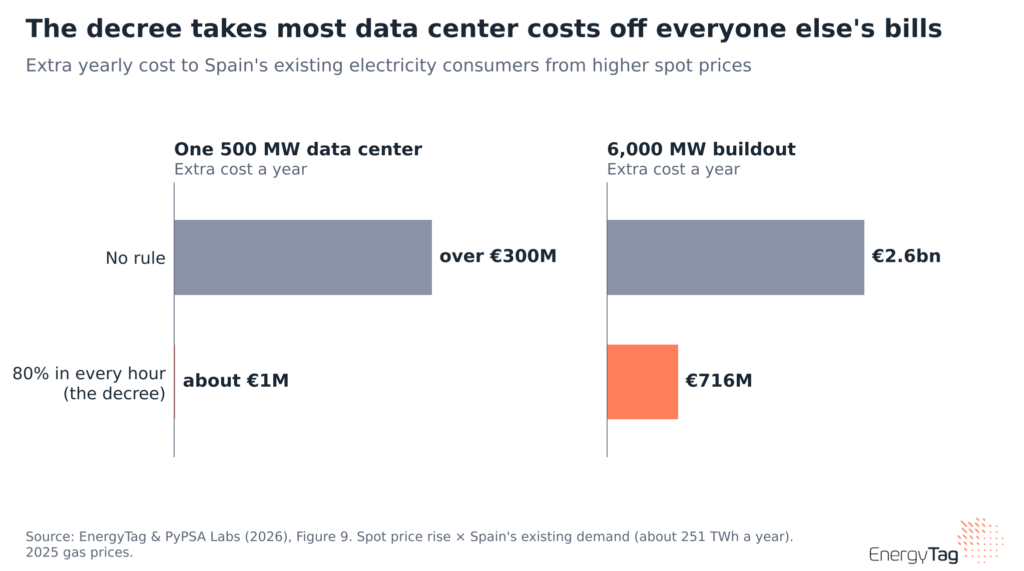
The chart here lays out why clean flexibility and meeting new demand with fossil fuels like gas is so problematic, from a cost of living and affordability perspective.
Because datacentres tend to continue drawing lots of power in the evening and through the night, if there is no new clean generation, this new demand will be met by burning gas. At other times of the year, when the grid is under stress, their continued use “makes the peaks, peakier’, pushing the peak demand on the grid still further. This increases the amount of gas burned as well.
Why does this make things more expensive? Generating electricity from imported gas is more expensive than other forms of power, and all across Europe, the way energy markets are structured mean that gas ends up setting the price everyone pays for power more often, which pushes up the cost.
These modelled examples show than when 6 gigawatts of new demand from datacentres come onto the grid, we see around 2.6 billion euros in extra energy costs socialised if there is no law requiring new clean power.
This means that as more datacentres are introduced, without changes to how they are powered, more of the costs of accommodating datacentres end up being shared with the rest of society – even under this law, which is the most progressive one we have seen, there are socialised costs.
This is also another reason why you see community pushback – in the middle of a cost of living crisis, having such a rich sector push up costs for everyone else is not a good look.
How it changed
Unsurprisingly, a rich sector like the datacentre sector has a lot of political sway, and there has been lobbying to water the law down. There have been a few changes, like making this law only apply to a larger class of datacentres, and relaxing the sovereign cloud commitments, but the main change has been in the introduction of a new route onto the grid for datacentre operators.
The target is still there, but with a new route via flex
Rather than needing to demonstrate 80% matching as a condition of being allowed onto the grid, the target was loosened to being 60% to begin with, but needing to reach 80% by a given date in the future currently 5 years from now in 2031.
There’s a catch though – datacentres taking this less ambitious path have to opt into an automatic unpaid scheme where they agree to scale down their power consumption when the grid is under stress. As we touched on before, when the grid is under stress, you usually have more gas being burned to meet the greater levels of demand, so this is intended to reduce how much costs get shifted onto the rest of society.
There is a risk that this part of the law opens the door to just burning onsite fossil fuels to provide this flexibility – something we identified in Ireland, where big providers like Microsoft have clearly visible on-site gas generation on their main datacentre campus.
There are other laws that disincentivise this though – in Spain, burning fossil fuels locally still requires permits that usually restrict how long you can run them, and this new datacentre law requires datacentres to reach minimum levels of water and power efficiency, something this kind of generation can effect.
What happens now?
We now have a law, which on the face of it requires new datacentres above a certain size in Spain to either run on almost fossil-free power, or do so inside the next 5 years. It also does a much better job of making the costs land on the actors expected to gain the most from this law. We think this law is likely to set various precedents across Europe if it survives.
Why say “if it survives?”
We have a few reasons.
Will it survive a national election?
This weekend, on November 29th, there is a national election in Spain. two right-wing parties (PP and Vox) vying for power with the current socialist government (PSOE) have pledged to dismantle this new law, and replace it with something much weaker. This is a law that was written in a way that didn’t require a vote to come into effect, which means dismantling it doesn’t require a vote either. This might be a short lived law if that happens.
The datacentre industry vs the rest of Spanish industry
As you might expect, there is also opposition from the datacentre industry to this law. There is already a legal challenge against the law by Spain DC, an industry association representing the datacentre sector in Spain, and more expected in the coming months.
At the same time however, there’s also evidence of a wider response against the datacentre sector by other industries in Spain who rely on access to cheap electricity, that the introduction of so much demand from so many new datacentres puts at risk.
They see the implied rises in the price of power as existential to them, as doubling the price for electricity can put some of them out of business, whereas the same rise can easily be tolerated by people operating datacentres and selling AI compute services by the hour.
What you can do
If you’re in Spain, you probably know there’s an election on, you can vote this weekend – this might be the single highest impact decision you can take in the next few days.
Otherwise, we’ve written elsewhere about steps you can take as a technologist, a consumer or a citizen, particularly when covering the recent day of action on datacentres we supported, and when covering developments in the legislative landscape in Europe.
We think open modelling like this can help people understand the implications of a new datacentre buildouts and have data informed decisions about how these changes impact society. We’re looking for ways to see this kind of modelling be replicated in other countries around the world. If you think you can help with this, through funding similar, or offering your skills in doing so, we’d love to hear from you – drop us a line.