Earlier in the year, we wrote about a new data centre labelling scheme proposed inside Europe, which would require every datacentre in Europe above a given size to disclose sustainability and performance indicators in a publicly available label. This label has been revised, and a set of new laws that use it are going through the legislative process in Europe. before coming into effect next year. So what’s in the label now, why does it matter, and what happens next? Director of policy and technology Chris Adams, gives an update.
Why do these performance standards and this label matter?
We have expanded on this in an earlier “part 2” post from earlier in the year, but for convenience, we’ve summarised things below:
- This label scheme has the potential to bring data that has not been visible into the public domain, that people have been calling for years – although as we’ll explain, there are some serious limitations to what is shared.
- Data like can be used to enable other forms of governance, and indeed one of thr first uses of the data is to decide what kind of public support goes to support the expansion of the datacentre sector.
- This is the first label for datacentres backed by disclosure laws at a per-datacentre level, which sets a precedent globally. It’s likely that other laws around the world will at the very least reference some of the ideas in this label scheme and the proposed minimum standards.
What was in it before, and what’s in it now?
Previously, we had a label that looked a little bit like this mockup below:
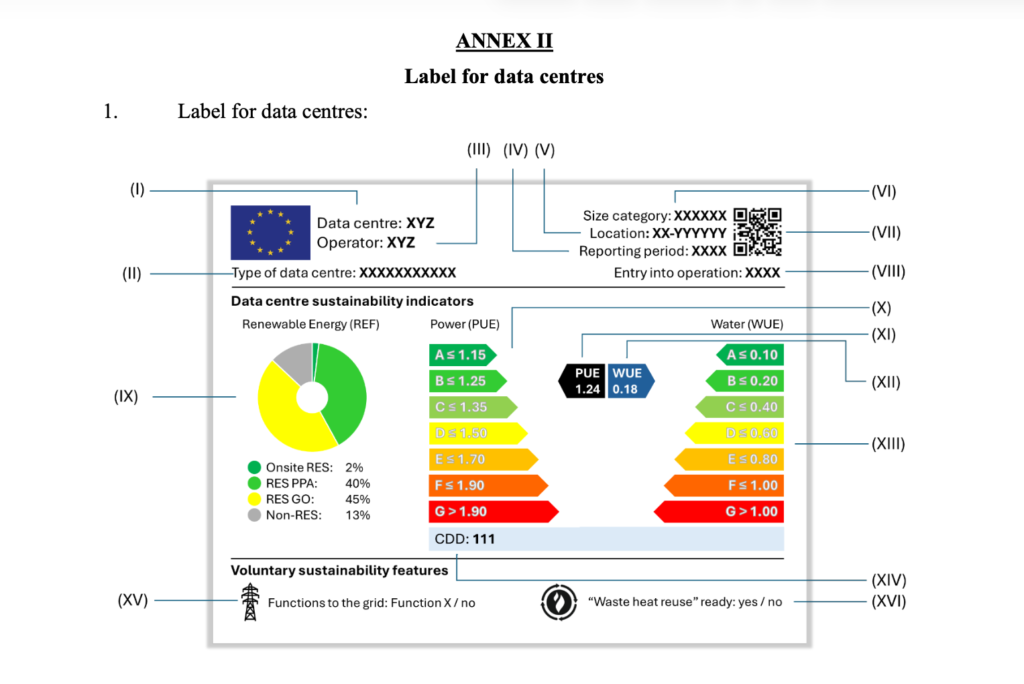
Again, in a previous post we go into a lot of detail about the key points of the label, but briefly, we see information about how efficient a data center is, who owns it, who operates it, where it is in the world, and how it is powered.
What does it look like now though?
Here is what the updated version of the label looks like – we’ve highlighted the key changes in red boxes. If you want the full set of changes, you can see both versions of the law text side by side in this nifty view from Draftable.
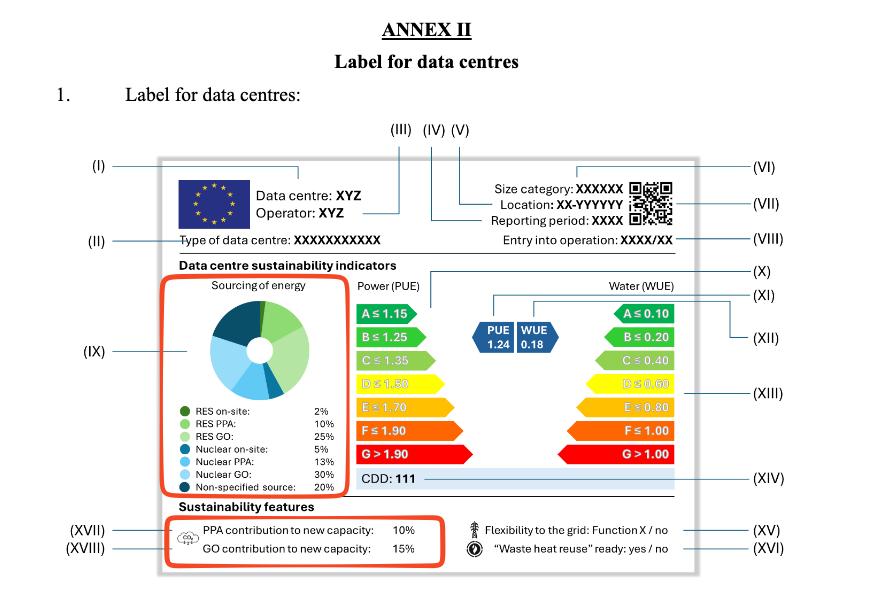
What changes are visible in the label?
At first glance the big change is a change in what kind of energy is recognised. Previously, you had a division between renewable and everything else. This was understandable given that around 80 to 90% of all new clean energy is expected to come from renewable sources and is necessary for decarbonising Europe, and because over the last 20 years, no new nuclear reactor in Europe has been built without the state taking on the risk that commercial actors were not prepared to take on themselves.
The point of a corporate power purchase agreement (the ‘PPA’ in the label above) is to take on the risk that makes building clean energy possible, and if it’s the government taking on the risk, it’s hard to make the case that it’s the corporation that made a project possible, and that it should receive special credit.
Under this scenario, it didn’t make sense to recognise a corporate power purchase agreement to buy nuclear power, or clean energy certificates from them, and relatedly these instruments didn’t exist anyway.
However, that was before.
Nukes have entered the chat
However, you can see the impact of different commercial lobbying groups in Brussels here in this label – rather than Renewable Energy Factor (REF) being written iton the law, you see Low Emissions Energy Factor (LEEF) in the language, and nuclear on the label.
Different sustainability features
Another addition is that you have new ‘sustainability features’ – this notion of contribution to new capacity is crucial, because if new demand is not being matched with new capacity, it effectively means it’s directing clean energy that would be used to decarbonize the rest of the economy, to power whatever is inside the datacentre.
So rather than being clean energy for decarbonisation of demand, it becomes clean energy for expansion of demand.
Other details not in the diagram
In the earlier post, we had raised a few issues about things that you cannot see in the label. We’ll pull out a couple here.
Similarly lax definition of renewable energy
Under the revised label, and definitions of energy linked to it you can still run a data center on fossil fuels in Germany, and as long as you buy the same volume of clean energy certificates for solar somewhere else sunny, like Spain, and claim the highest marks possible for sustainability.
You can do this without caring at all whether the time of use and the time of generation of energy matches up – things that are actually referenced in the law, in the form of language around temporal matching of power, and there being minimum ages for clean energy faciltiies, but they’re all totally optional.
We see this as extremely problematic, because it removes any incentive to make the meaningful investments in clean energy with the properties we need to clean up the grid.
It’s a fair question at this point to ask what are the properties you need then?
We’ve spent some time helping defining fossil free for digital with European standards body CEN/CENELEC – see this post for more – where there is language about timeliness, additionality, and deliverability, and also go into detail in our new verification criteria.
We also refer to it using these properties using the phrase new, near and now, to make it memorable.
Let’s run through these, as they’re the basis of where we are nudging providers our with our new verification .
- New – has to be new clean energy capacity, so you don’t take energy needed to decarbonise other sectors.
- Near – has to be clean energy on the same grid or deliverable to it, to incentivise decarbonisation where the demand is happening, instead of leaning on local fossil fuel generation.
- Now – has to be energy that matches temporally with consumption, to incentivise investing in the technologies we need to get fossil fuels off the grid. These mean things like batteries, and a portfolio of clean energy technologies together that complement each other, to avoid falling back on fossil fuel generation.
If this is optional, and with no legislative driver, you end up incentivising the least convincing, low ambition definitions of clean energy when you bring datacentres online, and that can be actively harmful.
From REF to LEEF
If you are not a fan of nuclear power, or fossil fuels with carbon capture and storage, you might take issue with the shift from tracking a share of energy coming from renewable sources – “renewable energy factor” or REF, to tracking a share from more than just renewables, and tracking “low emissions energy factor” or LEEF.
How can you justify this shift? The best argument we have found so far is that there is at least one example now of huge companies like Google doing deals that would extend the lives of nuclear power stations in Europe, that would have otherwise been shut down, taking clean energy we already have off the grid.
This could be interpreted as an example of a corporate power purchase agreement for nuclear power. However, this also raises all kinds of questions about the non-carbon impacts of nuclear energy, and ends up being a statement about just how big a role big tech companies have in society now, for this to even be possible. It’s arguably a pretty clear shift from the original intent of the proposed law as well – for many people renewables and nuclear are very different things.
The other issue here is it raises another question. What else you do let in when you claim “low emissions energy”?
Right now, LEEF is effectively defined as renewables, or nuclear. But the language leaves wiggle room later in 2028 when the the labelling system, and linked minimum performance standards are reviewed. Elsewhere in European law (specifically the EU taxonomy for sustainable finance) fossil generation, when paired with carbon capture and storage is still counted as “sustainable” for green finance purposes.
Given that according to the IEA, between a quarter and a half of US new datacentres being built look like they will reach for on-site gas as the primary source of power, this is one to watch like a hawk, because there are already signs of operators pushing for using gas in Europe if they can get away with it.
This datacentre label still has some big issues. Now what?
For this new labelling scheme to become a law that’s in effect, it needs to make it through scrutiny from the European Parliament (i.e. where Members of European Parliament, MEPs meet to deliberate on laws), and the Council of Europe (i.e. where ministers from every national government meet to do same).
This is normally a two month process, so it would have become law in late November/ December.
But earlier this month, the scrutiny period was extended by two months, taking us to January 2027 instead, meaning the law most likely comes into effect in February 2027.
If either the European Parliament or the European Council objects – and they can only object, not propose changes – this entire law gets killed, and things start over. The European Commission has to propose a new revised draft that they think will make it through.
If this law does go through, there’s a related, but separate discussion, and live active consultation about minimum performance standards for datacentres in Europe. If what we’ve been talking about so far is about what gets measured, that discussion is about how high the bar should be once you’ve decided what to measure.
So if, like us, you want to see a fossil free internet, there’s still a few things you can do.
Respond to the current consultation on minimum performance standards
There is an open consultation on the European Union “have your say” website, about minimum performance standards for datacentres, at a call for evidence phase. This is where your input can shape a law, before it goes through a whole scrutiny process listed above. The deadline is 14th December, you don’t need to be an EU citizen, or even living in Europe to respond, and you have the option to make our response visible to the world, or make it a private submission. Follow the link to the consultation site to learn more.
If you’re in Europe – contact your member of European Parliament (MEP)
If you’re in Europe, Members of Parliament are voted in to represent your interests, and they are the people who would be reviewing this law, with the ability to let it through via silent assent, or stop it in its tracks by triggering a vote to kill it in its current form. This is a pretty high bar though, it would take 361 out of 710 MEPs voting against the law for this to happen.
The European parliament has a handy site to help you find your MEP, and see how they vote.
Find out about the Stop Dirty Datacentres campaign day of action in November
If you’re not overjoyed at the prospect of support for massive datacentres being written into law, with large loopholes in transparency and oversight laws, you might be interested in seeing who else feels the same way.
Much like how the majority of the population in the US has taken a dim view of large fossil fuel powered data centers being built around them, there are growing signs of a backlash in Europe as well.
The Stop Dirty Data Centres EU campaign website has a list of organisations, and map of actions taking place, and some of our own staff in Berlin Germany, and Vienna, Austria and Bristol, UK are going to events too, to chat with others who want to see a fossil free internet too.
As ever, we’ll post more on the topic, but this should give you plenty for now. Onwards!