Authors: Gwendolin Barnard, Katrin Fritsch & Christina Gruber
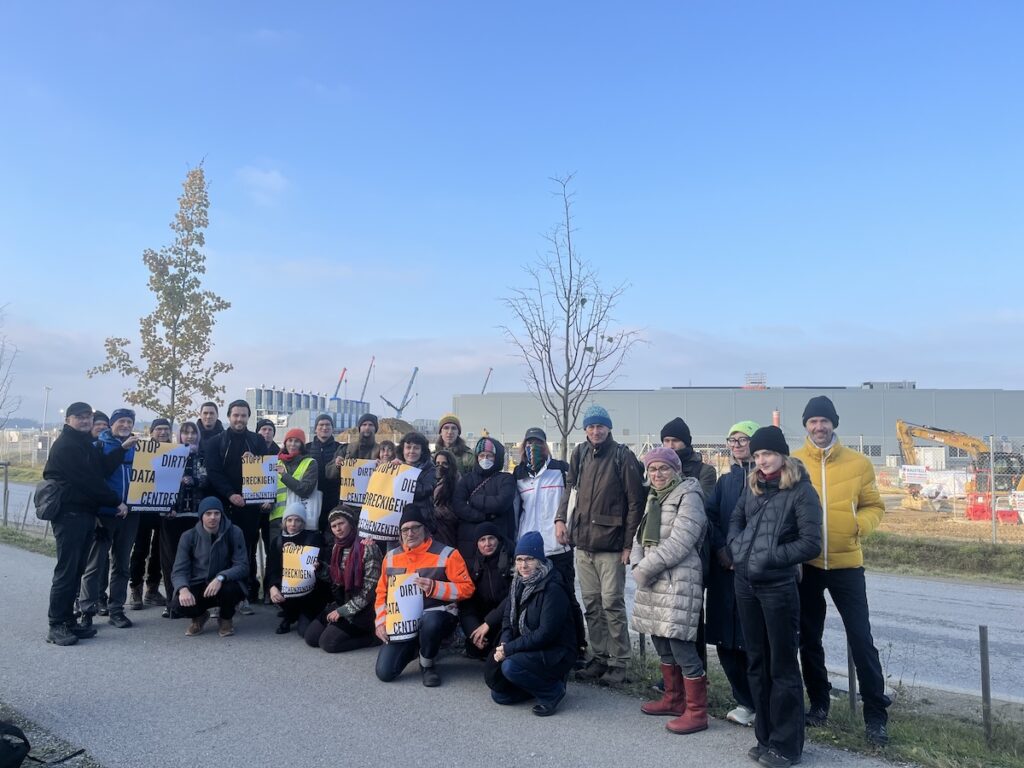
As part of the Europe-wide days of action calling for an immediate moratorium on large data centres, we visited the construction site of the Google Hyperscaler in Upper Austria, Kronstorf, on November 7th. We came together as a diverse group of people to explore the infrastructural dynamics and learn more about the activism on the ground. In this blogpost, we recap some of the insights we’ve gained.
The scale of the project
The hyperscaler in Kronstorf is located close to one of the four central points of the Austrian energy grid, a large substation powering over 1.5 gigawatt. It sits just on the other side of the Enns – the river that marks the border between Upper and Lower Austria and, for hundreds of years, forms a diverse ecosystem that has supported fishermen, farmers, and the local communities. It is of course also a valuable resource to cool the data centre.
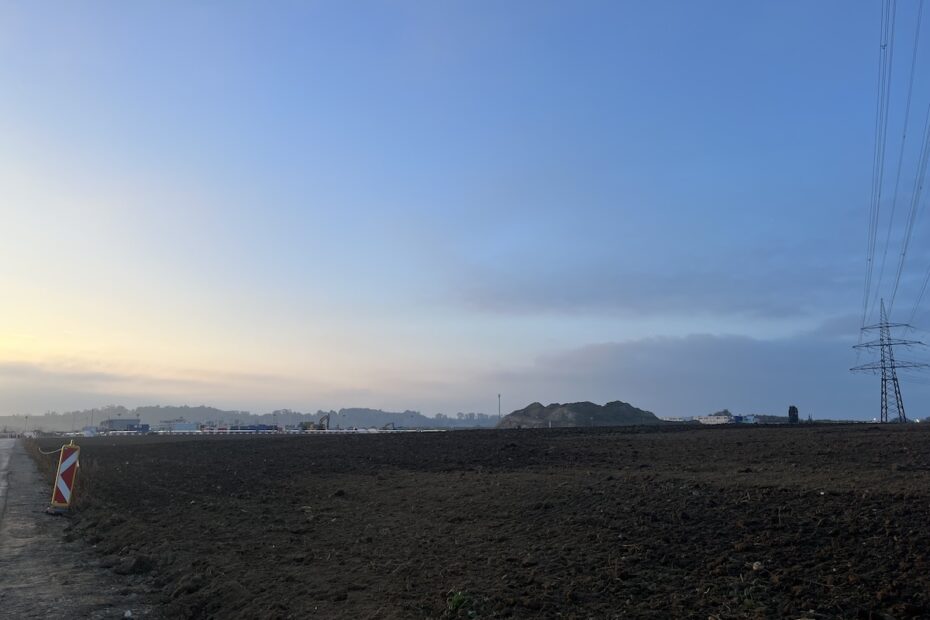
The hyperscaler is being built on former farmland, with two small villages close by. The location is right at the border to Lower Austria, which gives the project some legal freedoms (eg. complaints about noise pollution are difficult from one county to another). The landscape there is hilly and feels vast – it’s really in the middle of nowhere. Kronstorf has 3.500 inhabitants.
The Google data centre is planned to span across an area of a little under 50 hectares. The construction site started in January 2026 and is currently in phase 1. The construction plans have been kept largely intransparent to the public. Operations are planned to commence at some point in 2027. The negotiations for phase 2 and 3 are currently underway. The aim is to have 4 data centres built on this site. At no point in the process was an environmental impact assessment conducted.
Walking the infrastructure
We came to the site by public transport and the first thing we noticed were the four-winged farmsteads dotted around Kronstorf. The soil of Kronstorf is underlain by loess, which is a particularly fruitful soil that has the capacity to retain large amounts of nutrients over years. It is no wonder that the area was predominantly used for agriculture – up until now. Google started acquiring the land in 2008 when discussions and the scale of AI deployment were not even in their infancy.
We also immediately spotted the presence of the electrical power grid. There are hundreds of electricity pylons, and walking there feels like walking through an energy grid. There are other industrial buildings close by. The hyperscaler is only a twenty minute car ride away from Austria’s largest former Nazi concentration camp, Mauthausen.
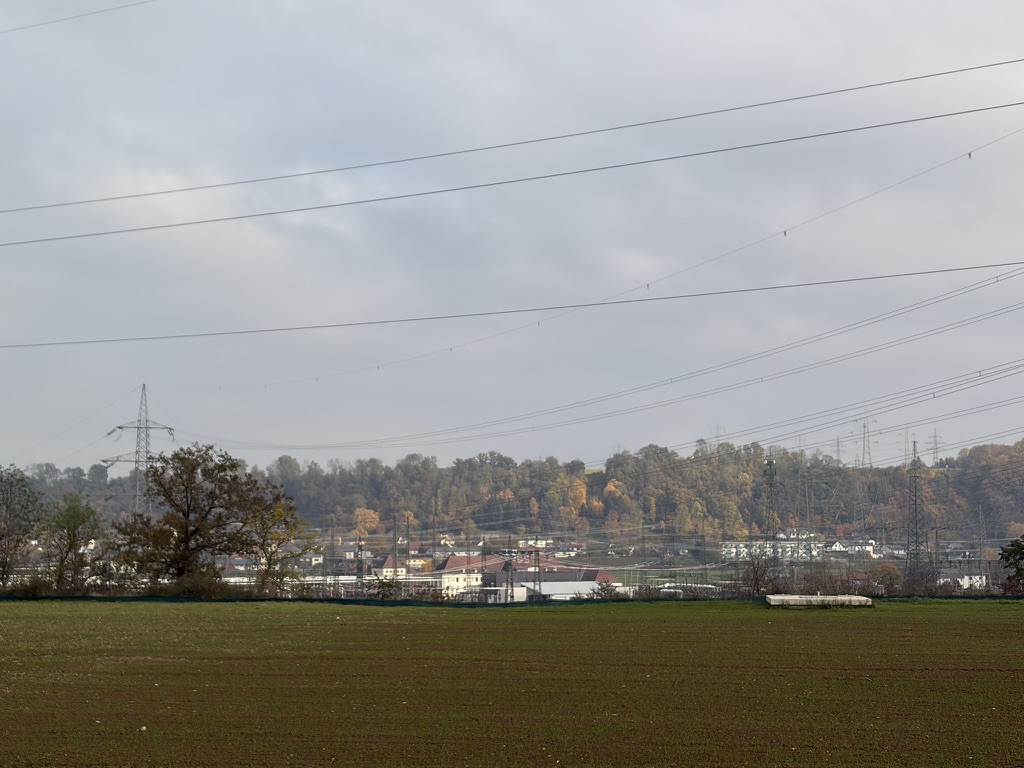
The first stop on our tour is close to the river Enns, where the pumping stations to cool the data centre are built. There are four stations planned (and some are already working). They can source water at 100 litres per second, but the data centre developers received the allowance to source up to 200 litres per second. The land where the pumping stations were built was a nature protection zone. We obtained documents that the protection zone was legally abolished by Upper Austria in 2014 in order to build the stations.
Local activists reported that it is yet unclear if the water will suffice to cool the data centre or if additional cooling provisions will need to be made.
The water used to cool the data centre will be a mix of water from the river and the ground, but only half of it will find itself back in circulation at a permitted temperature of up to 30 degrees celsius. The other half is expected to evaporate.
The Enns is an alpine river meaning that cool water from the mountains holds the water at a low temperature. However, due to climate change, this cooling factor is not guaranteed anymore. Currently the extent to which aquatic life will be impacted by the additional heat is unclear, but it can be expected that there will be more algae and parasites in the water. It is also unclear if the fish population will survive. The local fisherman’s association of Upper Austria has received funding for a renaturation project; the local fisherman’s club on the other side of the river, in Lower Austria, does not have the legal means to challenge the pumping stations because they are located in a different county.
It is particularly striking that the pumping stations were both built on a nature protection zone and next to a water protection area that serves to guarantee long-term access to fresh and clean water. In 2026, Kronstorf was hit particularly hard by the heatwaves over the summer which stressed the water supply – a trend that shows no signs of slowing down. The village Hagelsberg, three kilometres from Kronstorf, asked its inhabitants to save water in the 2026 summer.
Walking the industrial sites
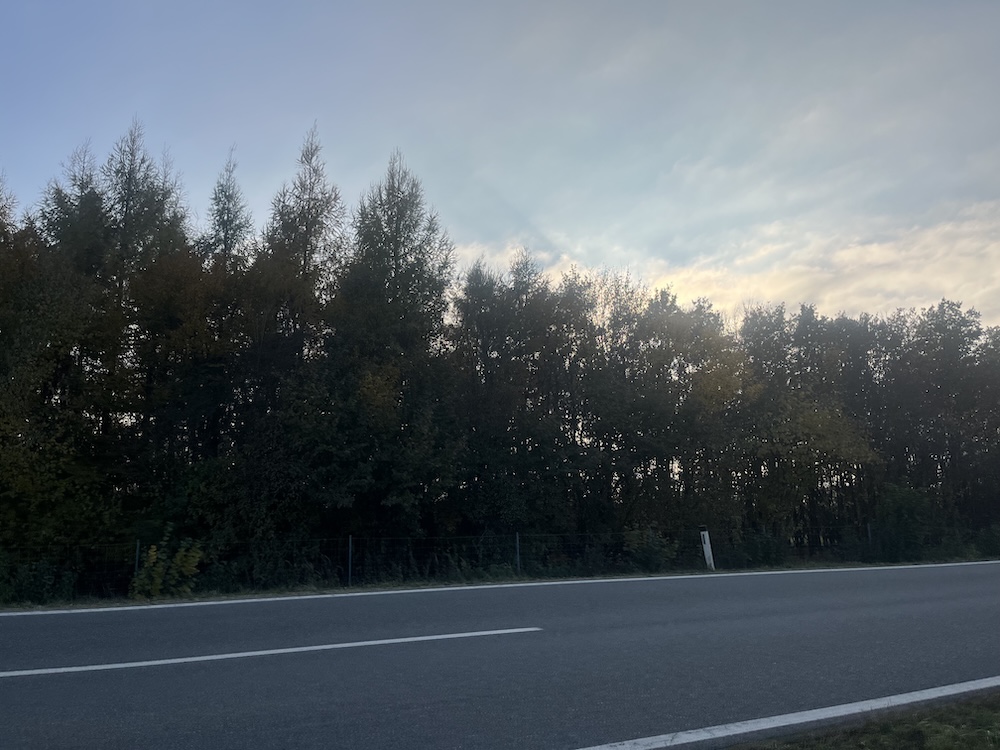
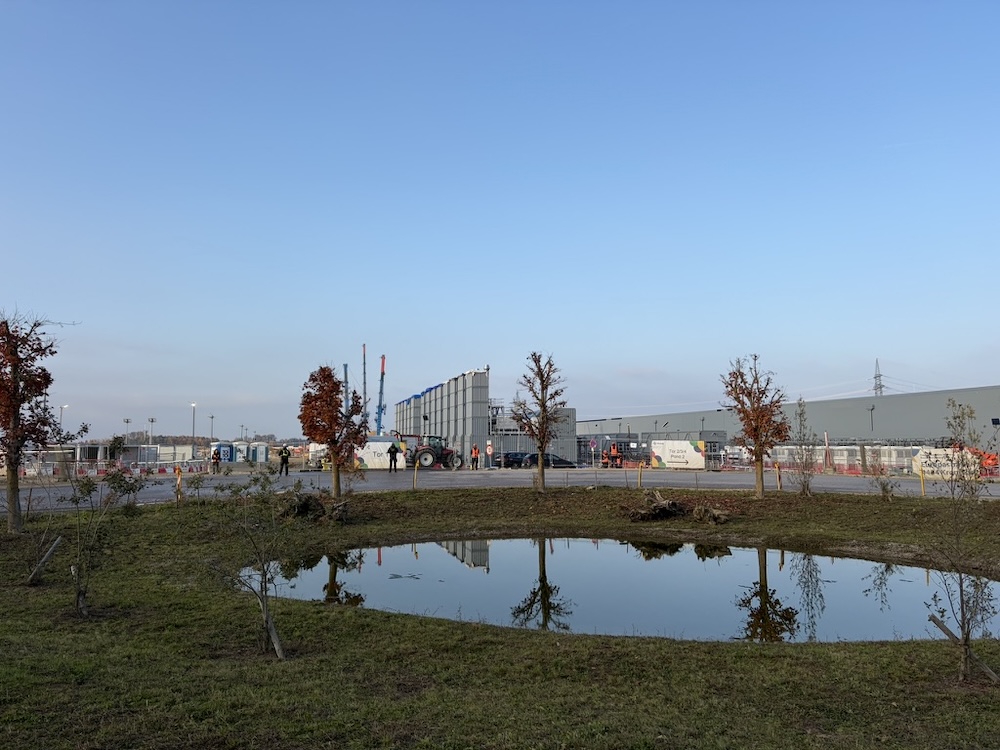
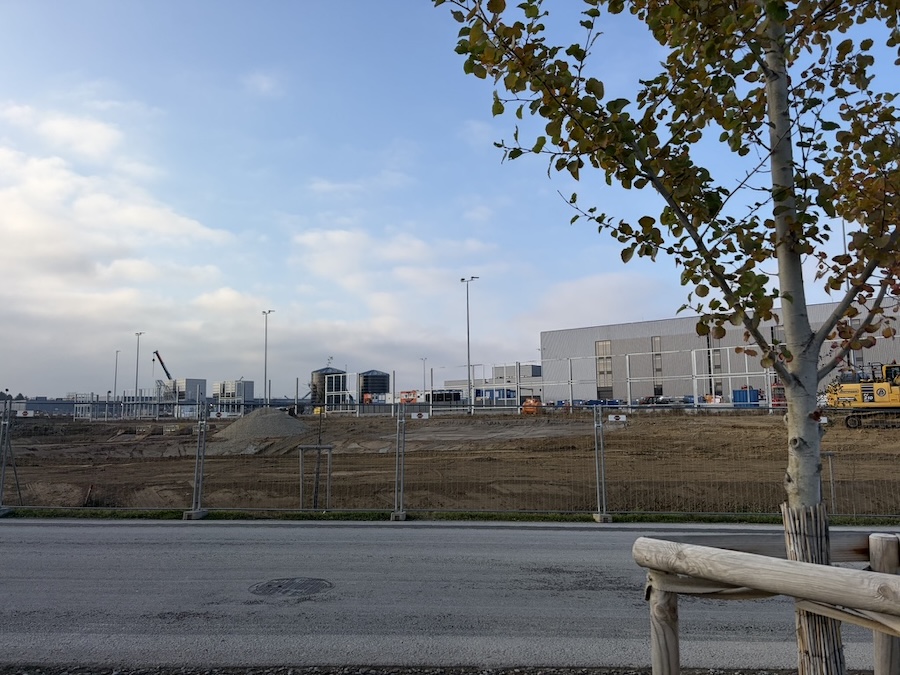
We then made our way up the hill and spotted an ominous warehouse owned by the German drugstore giant DM. The street leading up to the data centre hosts several newly planted trees and on the other side, the so-called ‘Google Forest’ was cultivated. This little forest is intended to ‘hide’ the data centre and provide some additional space for the animal population. We walk closer to the data centre and can already spot the securitisation of the site: there are surveillance cameras from a Bavarian surveillance firm and patrols of private securities. A large BMW, probably one of the security personnel, now follows us.
Particularly impressive are the 36 towers that are emergency aggregators powered with diesel. These should guarantee the smooth running of the data centre in case of an electrical black out for over 26 hours — an event that would use over 22.000 litres of fossil fuel. This illustrates one of the connections between the fossil fuel industry and the data centre buildout: with the rise of AI, the fossil fuel industry has found another customer base: big tech.
Understanding the social and environmental impacts
Visiting the hyperscaler really brings things into perspective: you walk through former farmland, and suddenly see a massive infrastructure project that is such a stark difference to its surroundings. Even while walking there, it is difficult to grasp the scale of the project.
The area where the data centre is being erected is not only fertile soil, but also an essential resting ground for migratory birds. Apparently, before the building works started, bird deterrent netting was laid out to prevent nesting birds from settling on the land. In the face of this, it feels particularly ironic that the warehouse operator DM created a tiny biotope by the entrance of the data centre surrounded by dead trees to balance out the environmental impact. A slow humming sound is accompanying our walk – despite the data centre not being in operation yet. At the height of summer, this sound should increase to up to 70db – as loud as a washing machine whilst spinning.
Exploiting legal loopholes
Local activists are attempting to get their hands on documents and data at every possible opportunity. There is very little transparency. No environmental impact assessment has been conducted. This would only be mandatory in the state of Upper Austria for an area of over 50 hectares.
Google, their consultants and lawyers, deployed a so-called ‘salami tactic’ where every single component of the data centre was assessed individually – such as the water pumping stations, the size of the land, and the diesel generators.
With this strategy, the scale of the project was kept largely invisible to authorities. The mayor of Kronstorf promised a ‘digital hub’ with employment opportunities, but currently it is assumed that the data centre will only create up to 100 jobs, an abysmal number given the large ground that is used up.
Where from here?
The scale of this data centre is unimaginable, and legally, there is little ground for Austrians to challenge the project. Walking there and learning more about the history and the efforts local activists have made, it feels like this project is a blend of local politics and hypercapitalism, with every single legal loophole found — and taken advantage of. The data centre is in the middle of nowhere, nearly invisible, and yet, it will impact everyone: it’s estimated to use 5-6% of the entire Austrian electricity demand. The local activists are doing incredible work, including Christina Gruber, who wrote this article with us. It is really thanks to these people who talk, are connected, challenge the developments, and demand transparency on a municipal level so that there is a bit more transparency in the process. You can find the citizen initiative following this link, and support with time or donations. There is also going to be an event in Vienna on December 14, 2026 at Flucc that you can join to learn more.
The good news is that Austria has a history of challenging mega projects.
In 1978, in a citizen’s initiative, the fully built nuclear power plant Zwentendorf was decommissioned. This makes Austria the only country worldwide with a fully functioning nuclear power plant that is not switched on because of civil organising and action. This is the movement we can build upon, and provides the imagination needed to see that there is still a lot of space for change.
On the way back to the bus, we see a large flock of black migrating birds. It’s beautiful to look at their changing formations, and we wonder where they are going to rest now that their landing spot is occupied by machines, generators, microchips and asphalt. Are they also asking themselves, while looking down on the data centre, what has happened here and what to do about it?