In this post, we look at how Cyberfusion, a European managed hosting provider, built support for carbon.txt into their platform, so their customers can manage the sustainability claims for up to hundreds of sites in one place. This was the first such integration we’ve seen so far, and it helps keep claims discoverable, up to date and correct – something increasingly important in regions with new laws around green claims, or where audiences want to see claims about sustainability backed with links to meaningful evidence.
Cyberfusion is a European managed hosting provider that has been in business for more than ten years, with datacentres in the Netherlands, and in Germany. They primarily cater to web agencies, SaaS providers and large platforms, providing ease of use and power tools to builders and developers.
For agencies that manage tens or hundreds of applications, or SaaS providers building their own product, Cyberfusion offers the Core platform: one platform for every customer project, paired with support engineers who speak web professionals’ language. Core provides tools to manage the entire lifecycle of web applications and websites, with, among others, full control over PHP settings, internet standards scanning, automatic database optimisation, and native support for frameworks and CMSes like WordPress and Laravel.
Core, and keeping sites compliant, fast, and secure after launch
Most projects start with a development environment, which web professionals easily create through Core. But once a project is live, other concerns come into play. For example, it’s useful to automatically check common security and performance issues, and provide clear guidance about who to contact for security issues.
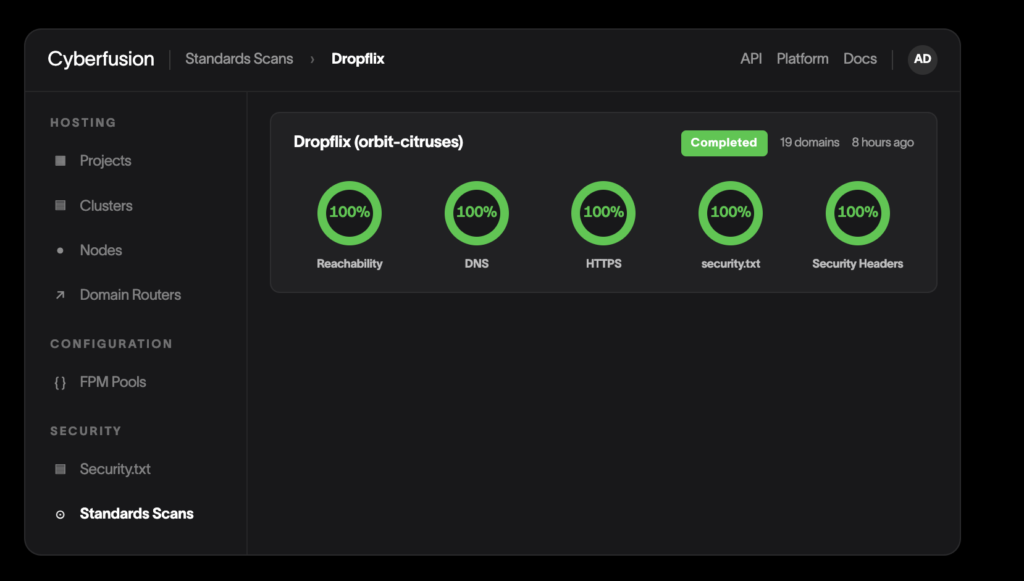
With this in mind, Cyberfusion Core offers features to support this, including built-in health and security checks, and was the first platform to offer native support for the security.txt standard. This is especially important for compliance in parts of the world that require security.txt files to be published for a website, like the Netherlands does for all its public sector sites.
The changing legislative landscape on green claims
Over recent years, new laws and standards for making green claims about products and services have been introduced, changing what can be said without convincing evidence.
For example, in the UK the Competition and Markets Authority has updated the Green Claims Code, with the threat of hefty fines on the table for the first time – up to 10% of global turnover hefty.
In Europe, we can point to the legal wrangling over the Green Claims Directive, and most recently, coming into effect this month, the snappily titled Empowering Consumers for the Green Transition Directive. This also introduces the prospect of hefty fines for non compliance. So like the UK, so it’s worth paying attention to.
With this in mind, there is a now-growing demand to be able to back up green claims about products or services with easily accessible supporting evidence.
Introducing carbon.txt
Carbon.txt is a scheme led by the Green Web Foundation to make sustainability data easily discoverable for a given domain, at a predictable place – so if you have a website like www.example.com, you’d have a file pointing to this data, that you, or a some code can reach www.example.com/carbon.txt.
This is similar to how approaches like security.txt, or robots.txt have worked previously, and it’s aimed at being readable to humans and software alike. You can see more on the carbontxt.org website.
Carbon.txt files work like indexes linking to sustainability data about a company or product, and one of our goals is to allow a similar ecosystem of automated checking tools to develop around carbon.txt, like we’ve seen with the other projects we’ve mentioned above. So, when a green claim is made about a company or product, the underlying data would be easily discoverable, because it’s linked in a carbon.txt file on the domain of the company making the claim.
This lets dedicated parsing software and other data processing pipelines consume carbon.txt files, following links to supporting documents within them, so claims can be independently verified, or so underlying information can be presented in new and helpful ways.
Adding support for carbon.txt in Cyberfusion Core
However, before any of that can happen, you need a way to get carbon.txt files online easily. And in an ideal world, make sure they link to current, valid data.
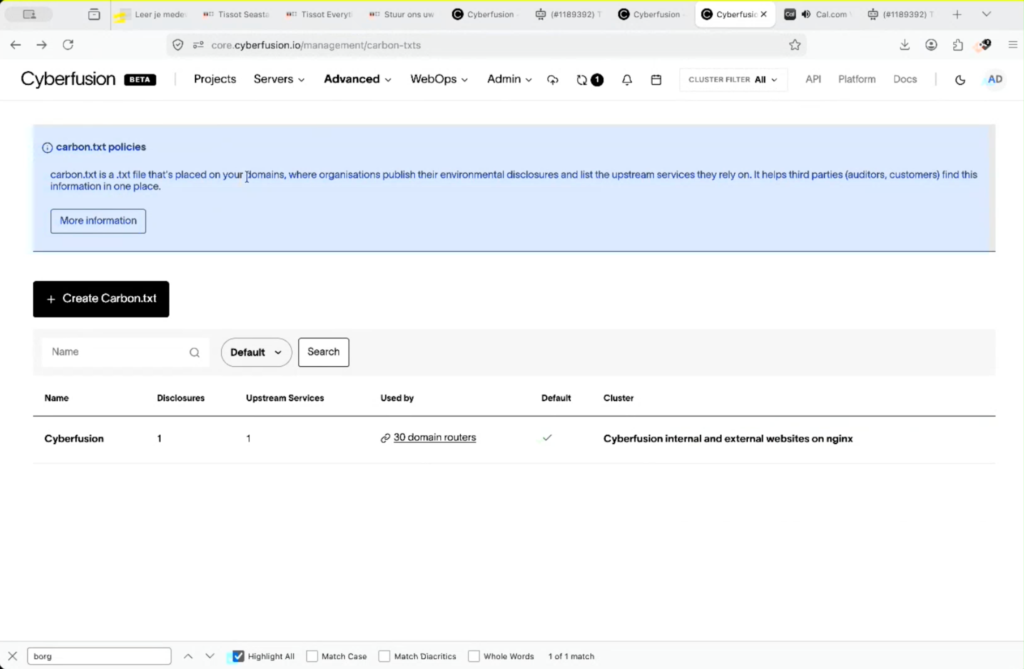
Cyberfusion is the first hosting provider in the Netherlands to integrate carbon.txt into their platform, making this possible for organisations managing tens to hundreds of sites.
Why Cyberfusion built carbon.txt support into their platform
Among others, Cyberfusion works for agencies that manage tens to hundreds of sites and applications. For that group, the incentive for carbon.txt is there, but they might be held back by practical concerns: placing carbon.txt files on hundreds of sites, and not only that, keeping them up-to-date.
Helping companies stay compliant is one benefit, but there’s an efficiency and supply chain angle too. Here’s what the William David Edward at Cyberfusion said about the attraction to them:
In my view, the big benefit of an initiative like carbon.txt is its standardisation: thanks to the fixed structure, it’s easily consumable by any person and system, and can be rolled out across the internet in bulk – especially when large-scale organisations like Cyberfusion offer an easy way to do so.
To make sure users don’t only add these carbon.txt files easily, but also keep them up-to-date, Cyberfusion implemented an automatic validity check: if any URL in any carbon.txt file no longer works, customers are proactively informed, so they can update their carbon.txt. That way, these files do not get stale and they are truly useful.
Making rollout easy in their platform
Being able to manage carbon.txt files across multiple domains is critical to agencies. This was one of the key drivers of adoption in the first place – supporting sustainability-minded companies in a convenient way:
We have a number of customers that focus especially on sustainability, who are the first to go for a feature like this. Because users can roll out carbon.txt files on all their sites and applications on Cyberfusion Core, with literally two clicks, we are seeing more generically positioned customers opting for this feature as well. Feedback is positive, no less because our customers get a good rep with their customers.
Open sourcing their approach for others to adopt globally
For other companies offering hosting platforms, the approach used by Cyberfusion is replicable, and has been open sourced so it can be used by others. It builds upon the original carbon.txt validator published by the Green Web Foundation in late 2024, available on GitHub.
It’s been thoughtfully designed to work with the rest of the ecosystem developing around carbon.txt, and Cyberfusion open-sourced the carbon.txt server they built and use themselves, with code examples on how to use it shared back to the original carbon.txt project documentation.
William explains how it works:
If we see a request to /carbon.txt on our load balancers, and a carbon.txt is configured for a domain, we route it to our carbon.txt server. This means users keep the freedom to configure a carbon.txt themselves (for example, using the GWF WordPress plugin). In other words, we don’t ‘hijack’ carbon.txt if not configured through Core.
From our perspective at the Green Web Foundation this is a model we’re now looking into more – allowing people to set sensible defaults, and take advantage of platforms their sites might be built on, whilst still allowing an ‘escape hatch’ for custom code or introducing new ideas into the community.
Next on the roadmap
Now that carbon.txt is built into the Cyberfusion Core platform, with continuous validation built in, what else is on the roadmap?
We are looking into automatically scanning customer sites and applications, so that they get insights into how much CO2 all their projects emit in one easy overview. After speaking to GWF, we learned of several useful open source projects, which would allow for making further claims about the sustainability of sites, and showing the underlying data that backed them up. We could link to that in a carbon.txt file too.
Conclusion
As we use the web more, we end up placing new demands on the applications and websites hosted online for us. Similarly when we talk about how ‘green’ services or products are, the bar is getting higher, where claims increasingly need to be backed up with credible data.
Carbon.txt creates a predictable place to look for this kind of data online, and integrating support for it into the managed hosting platform Core allows organisations to easily back up their green claims with credible data.
Using our own software validator libraries gave Cyberfusion a head start in building their own checking and builder tools needed for these new features in their platform. Because the our libraries and their own carbon.txt server are open source, other hosting providers can benefit from them too, helping develop an ecosystem around more credible, discoverable and usable data to back up green claims online.
If you’re a hosting provider looking to implement something similar with carbon.txt as well, or want to learn more about digital sustainability in the wider sense, you can get expert help from the Green Web Foundation – see our services page for more, or drop us a line via our contact page.