Earlier this year, the European Union began work on creating a new datacenter sustainability labelling scheme, that would apply to every datacenter above a certain size in Europe. This would mean that every single datacentre it applied to would have its own, unique, online, publicly accessible, machine-readable label, listing a bunch of key indicators relevant to its environmental impact, that you could share a link to. As an organisation interested in seeing a fossil free internet by 2030, and wanting to see more transparency in the sector, this obviously caught our interest, and like many others, we responded to the public consultation. In this post, our Director of Technology and Policy Chris Adams puts this label in context of the wider legislative landscape, summarises our key points in our response and shares some further analysis of where this might go next.
First a bit of context – what is this labelling scheme and why does it matter?
Rather confusingly, this is not exactly the same as some parallel work on minimum performance standards for datacentres we wrote about before, but it is related, and closely enough for us to consider as part of the broad topic. For that reason, we’re treating it like the same series of posts, as it turns out to be hard to talk about a labelling scheme that communicates what might be “good” or “bad”, without also talking about what the minimum standards of something might be.
The other thing to bear in mind is that later in May, the European Union will be announcing a package of support measures related to a new law, the Cloud and AI Development Act. This is expected to set out the regulatory environment intended help the continent achieve its putative goal of tripling datacentre capacity within the next 5-7 years, all with sustainable datacentres, in a region that already has established legally binding climate targets.
These minimum standards and labelling are expected to play a part in deciding what support goes where, as a way of telling more sustainable facilities that deserve support apart from less sustainable ones that don’t. They also are expected to also influence a good chunk of the already announced “InvestAI” spending announced last year – which already represents north of 200bn euros of spending from public and private sources.
Outside of Europe, like we’ve seen with other laws, it’s likely that what gets passed where will also influence other laws around the world – if only because when doing business with countries in the European Union bloc, having comparable standards makes working across borders simpler, or in an increasingly digitalised world, deciding where to run the next cloud and AI job for the best price and lowest environmental impact.
What’s currently proposed in the label?
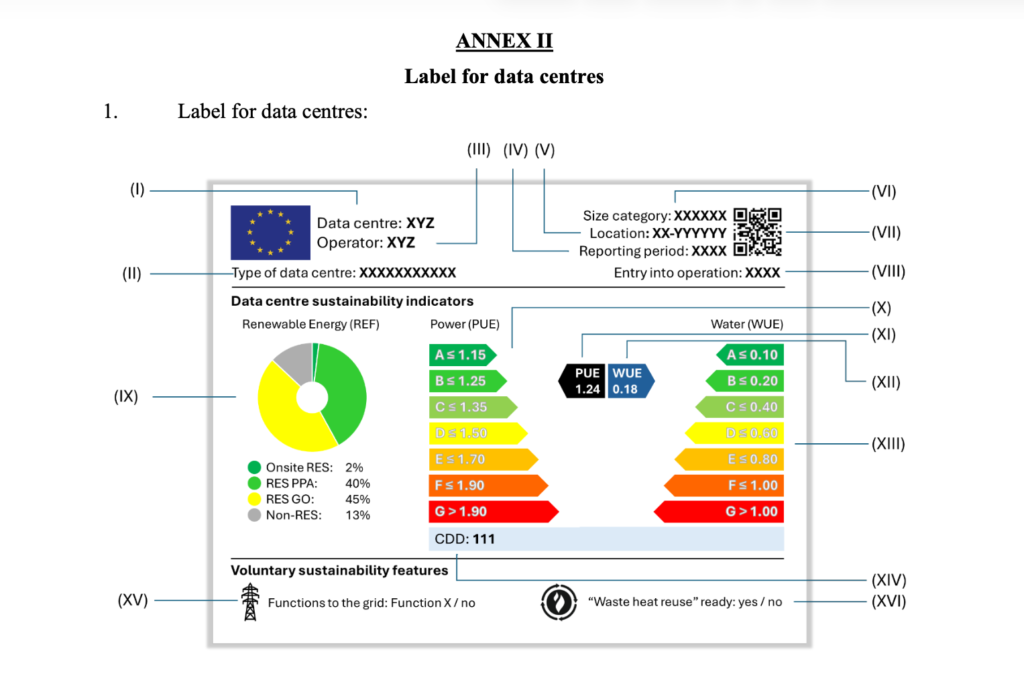
When the have your say consultation was announced, there was one label shared as a starting point for discussion in the draft law. We’ve included it below, but because it’s quite detailed, we’ll add a bit of commentary to help make it easier to understand, drawing attention to a few key points:
What are we looking at?
This label mockup was shared as one of the add-on annexes (think of them like attachments to a proposed law) to the draft legal text, and was intended as a starting point for discussion about what information might be communicated. We admit there’s quite a lot to take in here, and a fair few technical jargon terms. Rather than run through every single detail point by point, we’ll focus on what some of having some of these metrics visible might mean, and where relevant, what is or is not being disclosed.
1. Better detail on how how ‘clean’ the energy is
See the part saying Renewable Energy (REF) with the multi-coloured donut visual? This is showing you four things for the first time.
Onsite RES refers to local generation, like solar panels on a roof and so on. This generally powers a tiny, tiny fraction of the power used by a given data center normally (although there are exceptions, like Datacentre Light with their own hydropowered-generator, or Windcores, who actually put datacentres inside wind turbines).
The majority of the donut chart (the yellow and lighter green bits) though correspond to RES PPA (renewable energy from a long term power purchase agreement) and RES GO (renewable energy certificates, bought separately from power). These are by far the more common ways of powering a data center with cleaner energy.
Seeing this broken out is also welcome, because for lots of people, the ‘unbundled’ certificates people frequently purchase to be allowed to make claims of powering a datacentre with renewable energy are increasingly viewed as a problematic shortcut in their current, annual form.
In the current draft of the law, there is now some recognition of much more credible “three pillars’ style certificates. To use these certificates, you will need generation that is “near” – on the same region of the grid, “now” – matched to the same 15 minute period as consumption, and “new” – from clean energy generation facilities set up in the last 10 years.
If these were the only kinds of certificates accepted, this would be a significant improvement on where we are, but there’s a unfortunate get-out clause saying these are not needed if the organisation in a country responsible for issuing certificates doesn’t support these more granular certificates. We’ll have more to say on this in the section below with our response.
The final part of the donut, the Non-RES part is also a mixed bag. This might do a better job of helping people understand that power frequently comes from lots of forms of generation including non-renewable sources, even when they say they are at 100% renewable energy. But right now there’s no way of representing the depressing new trend that we might call recarbonisation – using new on-site fossil generation to power particularly power hungry datacentres, as opposed new clean generation. This actually is something that is captured in the annex linked in the draft text of the law (we detail more in a discussion related to cloud datacentre standards), but it’s not visible in the label at present.
2. Indirect information about the actual energy consumption / emissions
The other thing you might see is that there is not much in the way of detailed information about actual size of the data center. Datacentre operators do need to report the annual energy consumption (i.e. how much it used the last year) and the capacity of the datacentre (how big the datacentre is) to their regulator now, lots of operators fight really, really hard against this coming into the public domain.
Instead, we see in the label a size class, which following the current classification, is likely to be split into a 5 classes measured in Megawatts (MW), from 0.5 MW , 1-2 MW, 2-5 MW, 5-10MW and 10MW+.
The majority of data center capacity expected to be built in the next few years, particularly the large AI datacentres, now tends to start at around twenty megawatts, and is often measured in the hundreds of megawatts. The current scale misses out on this massive shift in size.
3. A publicly accessible link to this disclosed data, for every datacentre covered by the law
The presence of a QR code on the label is also interesting, and from our perspective, the importance of this is under-estimated. The draft legal text is pretty explicit that this QR code will need to link to a specified section of dataset related to that specific datacentre. So basically, for the first time ever, we’ll effectively have a public link for every datacentre this law covers. The information in the label also has to be machine-readable, and third parties are allowed to republish it – this is good news for re-use.
This is a significant step forward over what we had before, where information about datacentres was only published at country level, like this dashboard. It also means that in theory, things like our Green Web Check tools could point to them when you look up a site in future.
4. Performance bands for the power efficiency and water efficiency of a datacentre
This is what the coloured bands on the right of the logo propose. Again, this information is captured in more detail by the proposed law, with companies having to actually disclose the quantity and kind of water they use each year. What will likely be exposed though is the rate of water use per unit of electricity consumed, for water (WUE), and how much power ends up going to cooling the datacentre rather than to computation (PUE).
Again, this is more data than we have right now, but some pushback came before from the fact that these figures do not take into account that water usage matters more in an arid climate, in say… Spain than somewhere with a lot of water, like in Scandinavia.
With that in mind, you can see a CDD (cooling degree days) section, with the idea that hopefully places with very few cooling degree days also correlate with places where water isn’t in such demand. In some places this assumption holds true, but it’s not universal, and this is likely an inclusion because it might not have been clear what publicly accessible data to use instead.
5. Binary, true/false disclosure on whether a datacentre can interact flexibly with the electricity grid it connects to, or shares heat back
At the bottom of the label was a section that we expect might be the least likely to remain unchanged. You can see why there was an attempt to reference these two emerging properties of datacentres, as there is a lot of hype about both, but in their current shape, they’re arguably not that helpful.
There is now a developing vocabulary that can be used to describe how a datacentre can work in ways sympathetic to the grid – you might talk about how much of a datacentre’s capacity can flex, and how quickly, how long it can reduce the power it draws from local electricity grid and how often it can do this, but this isn’t really captured by any standard in widespread use in datacentres.
Similarly with sharing heat back, there are metrics usable there too, beyond having a simple binary. You might ask questions along the lines of how hot is is the reused heat? How much is provided?, and some of this is actually collected in the related EED laws. Energy re-use is potentially very helpful in places where heat is otherwise generated from burning fossil fuels – but you lose a lot of this information with a binary marking.
6. Blanket confidentiality for every piece of data not displayed in a label
One of the most controversial, in our opinion, most undemocratic and anticompetitive parts wasn’t actually in the label but instead referred to how data collected through legal processes, but not in the label should be treated. In the new draft law there was some new language that essentially would apply blanket confidentiality to information relating to a datacentre that wasn’t displayed the label.
This was a new addition, and has led to accusations of copy and paste lawmaking by lobbyists, as covered in The Guardian in the UK, Le Monde in France, El Pais in Spain, Tech Policy Press, and more.
We’ve attached a screenshot from one of the journalists who broke the story below, and you well… you can draw your own conclusions:
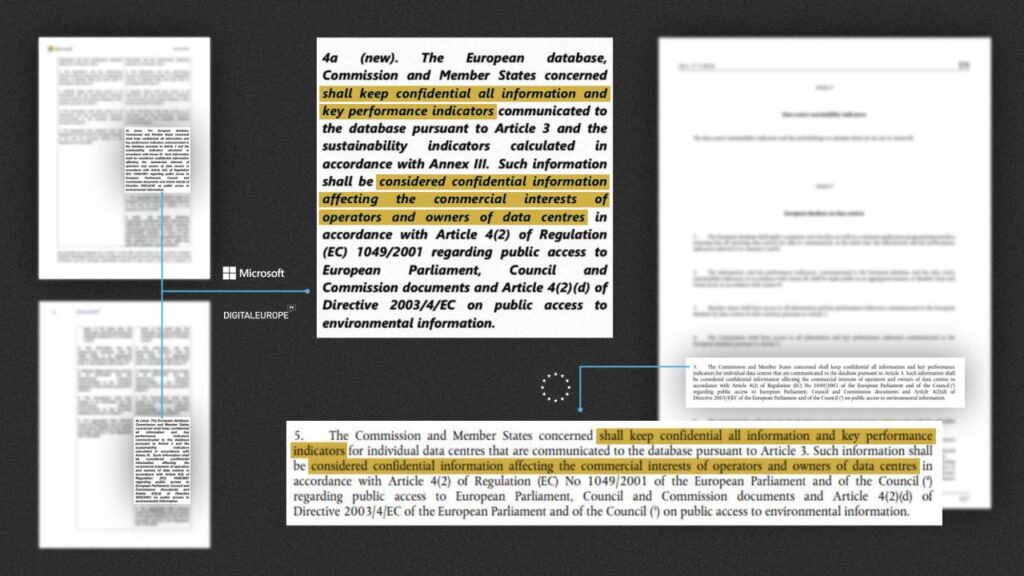
There can be valid reasons for commercial confidentiality, but its not hard to see how a blanket presumption of secrecy written into a law places the needs of large companies ahead of well… everyone else.
7. Rounding-error level fees for noncompliance
Finally, you might ask – if datacentre operators are already trying to get the law changed to avoid disclosure, what happens if they don’t play ball and disclose at all? We’ve already seen that participation has been patchy with the related Energy Efficiency Directive.
At present, any penalty fees for non-compliance are addressed at a country level, because the Energy Efficiency Directive needs to be written into national law to apply, and this new datacentre labelling scheme relies on the penalties laid out there as the driver of action. Directives set out what a law should say – so if we look to that law, we should get an good idea. If we follow original text, we can see that language says penalties provided for shall be effective, proportionate and dissuasive.
Looking across a few countries, we see that penalty fees tend to be in the tens of thousands of euros at present. This might seem a lot, but once you take into account that even the smallest 0.5 MW datacentres covered by this law are likely spending at least 600,000 EUR on electricity per year, you quickly see how a larger datacentre spending tens or hundreds of times as much on electricity might see a fine like this as a simple cost of doing business, especially if it means they can then avoid disclosing anything.
What was our response?
You can see our full response to the consultation elsewhere on our website, but for convenience, a summary is below:
- Require the more granular certificates to support claims of green energy, for both power purchase agreements (PPA’s) and for unbundled certificates (GO’s). This shouldn’t be a surprise. Green energy needs to mean something, and offering an easy get-out clause means making 100% clean energy claims will stay riddled with the problems we see now if using credible evidence is optional. Without this, you can still end up with fossil fuels powering most generation.
- Take into account local water stress better in WUE display to avoid incentivising inappropriate cooling, or moving it to where power is generated instead. Perversely, not taking into account local water stress can create the incentive to use more traditional style ‘mechanical’ cooling that uses less water, but consumes much more energy, because it can give a better WUE figure at the datacentre. the problem here is that it isn’t getting rid of power consumption – it’s just moving it somewhere else, because you end up needing to generate more energy to power the less air cooling systems, and electricity generation by itself can be a huge driver of water consumption (particularly fossil fuel generation, that uses this water for cooling).
- Represent datacentre flexiblity in a more fine-grained way, and do not recognise flexibility from on-site fossil-generation. While it’s early days, there are some emerging classifications that go beyond a simple yes / no for flexibility. We highlight some, and where they might need guardrails to avoid incentivising on-site fossil fuel generation.
- Do not assume an automatic blanket presumption of secrecy for information about datacentres – while there can be valid reasons for commercial confidentiality, the idea of applying it all data, particularly when this is likely to influence how huge amounts of public money is spent subsidising companies in the sector is undemocratic and not in the public interest. It may conflict with various laws guaranteeing citizen access to environmental information affecting them, like the Aarhus Regulation. (Update – this argument has now been made by more than 30 MEPs
If you’re curious, you can see our response on the EU have your say website, along with submissions from various other providers like Amazon, Microsoft, Google, Digital Europe.
What happens next?
This is expected to give a much better idea of what public support will be available as carrots for the digital sector, along with what sticks might be used to encourage the sector more closely align with the continent’s own policy goals. Work on the minimum performance standards for datacentres is still likely to continue, with new workshops, and we’ll likely write a post like we did with the last one.
In addition, May 14th 2026 is the next E.E.D. day, where datacentres above a certain size are expected to disclose the kinds of data that would be visible in these labels. We’re hopeful that there will be better take-up than we saw last year, and when we know more, we’ll post something about that too, as is part of a tradition.
In-line with updates to our verification process, we’re making changes to our platform – as we learn more about this labelling scheme, we’d love to be able to update our platform to make use of this new data in the labelling scheme being available. If this sounds interesting to you, drop us a line we’d be happy to chat.