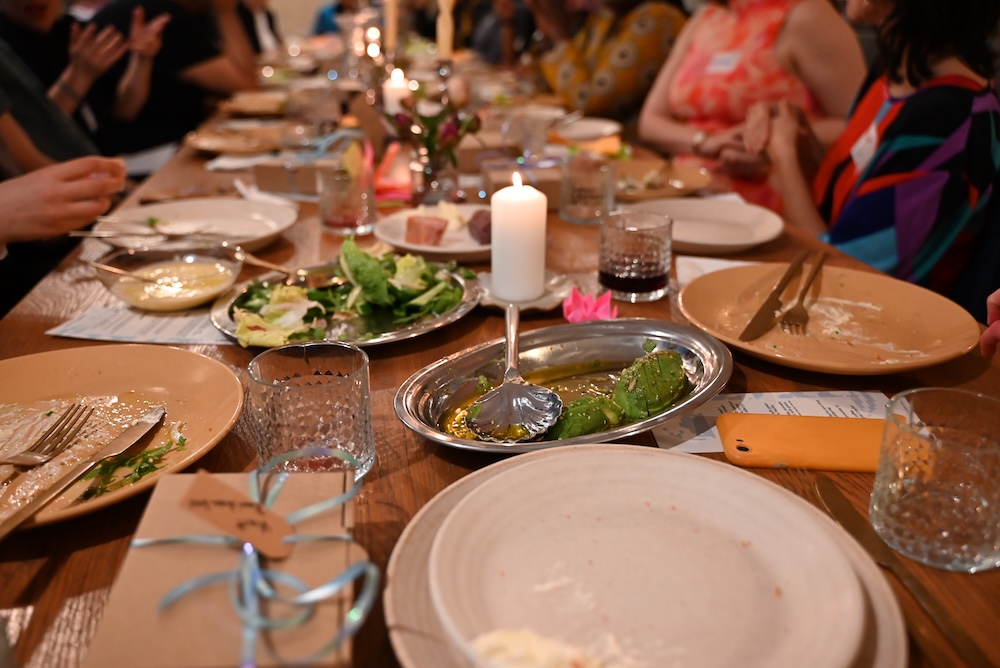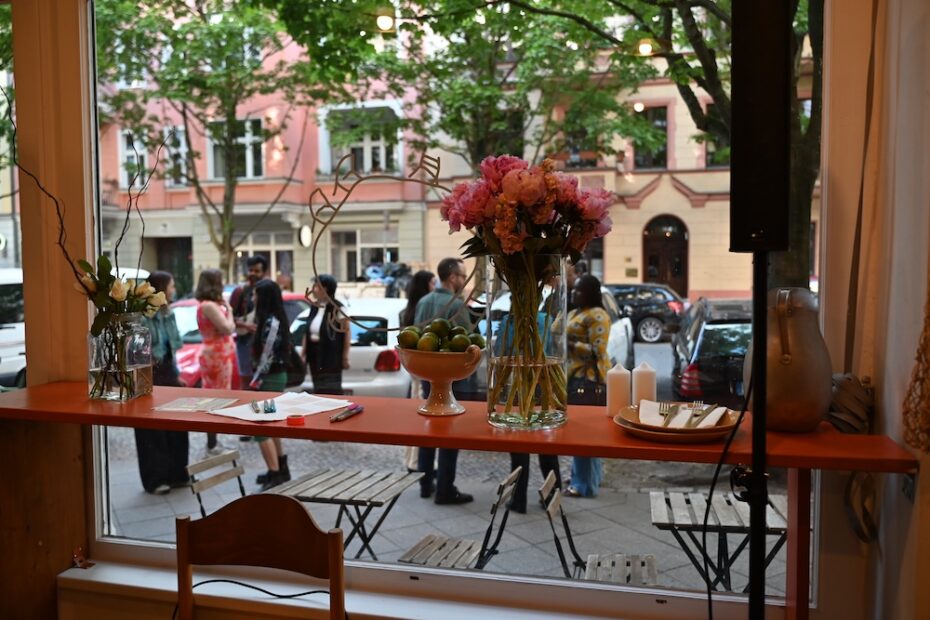
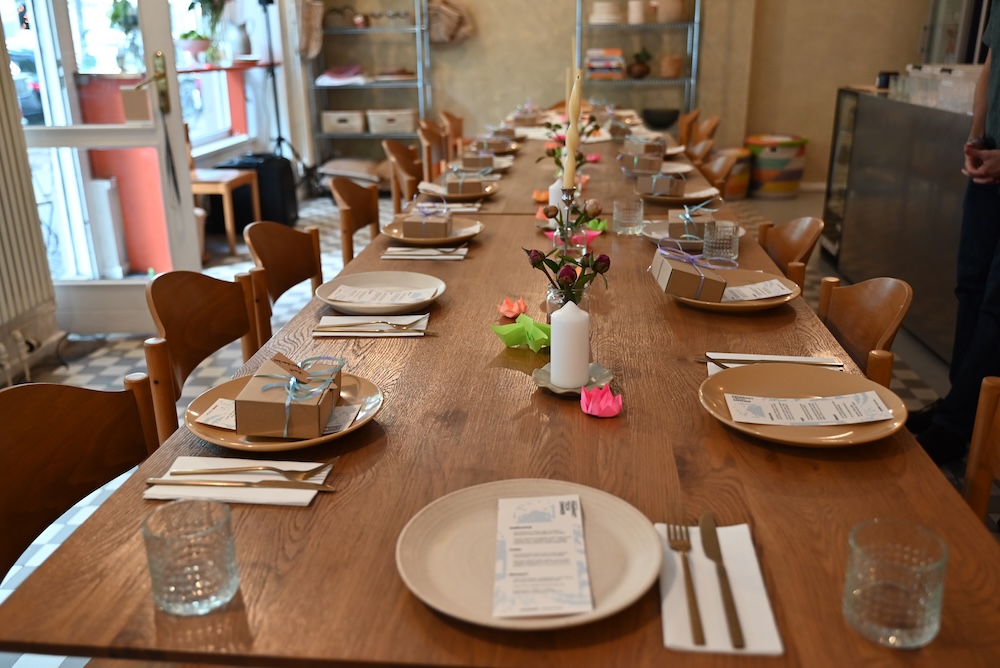
Last week, together with collaborators at Superrr Lab, we co-hosted a Regenerative Feminist Tech Dinner, an intimate event format designed to bring people from different spaces, communities and sectors together for an evening of deep and nourishing conversations. This is the recap of the event.
At Green Web Foundation, it matters to build bridges across different networks and gather ideas on how to support more alliances against extractive powers. That’s why we were very excited to team up with Superrr Lab, who have a track record of hosting Feminist Tech Dinners. At these dinners, they have learnt that sharing food together and bringing a level of intentionality and care to the space opens up the possibility for deeper conversations than at regular networking events.
In preparation for the dinner, we asked all invitees to consider this question:
Where have you experienced glimpses of a more just and life-affirming relationship with technology—and how might those moments guide us in resisting extractive systems and building alternatives together?
With the theme of regeneration at the centre, we talked about a wide range of topics. Data centres were a central topic, and how they represent exploitation in the physical and digital realm, taking up huge amounts of land and resources. They lay the groundwork for a very specific type of future in which compute power, unlimited growth, monopolies and stock markets play a huge role.
At the same time, the lack of nuance in the language we use around these topics also came up: as we and many others have written about before, ‘AI’ has come to mean a lot of very different things, and there’s currently no agreed-upon definition. The same is true of data centres – are we talking about a small room with a single server, or a massive set of buildings hosting thousands of servers, requiring extensive cooling infrastructure? Without specificity and agreed-upon definitions, it becomes almost impossible to know that we’re talking about the same problem, let alone move towards solving it.
The question was raised whether this might be an intentional strategy to obscure the actual structures of power in place.
Our dependence upon tech infrastructure coming from deeply problematic sources came up, too: Elon Musk’s Starlink, a system for providing satellite internet, provides internet coverage in areas where governments have intentionally cut terrestrial internet coverage, allowing for communication to the outside world. For some, this is extremely life-affirming: it is absolutely essential, and yet the extremely undemocratic ways in which those satellites are governed and managed (as well as the fascist roots of the owner) remain present.
In some ways, this was almost typical of many of the discussions we had: there’s no binary yes/no, good/bad, but instead a desire to acknowledge complexity and move through it to find better routes forward, while knowing that compromises will need to be made. That’s true in the way we use tech today on so many levels: from the exploitative conditions behind lithium or cobalt mining, and the horrendous environmental impacts of creating consumer electronics, to the acknowledgement that for some, AI does provide extremely useful functions.
The level of investment that is being poured into some of these infrastructures – whether that be satellite internet or the incredible level of data centre infrastructure that is being built right now – is almost beyond comprehension at this point.
It begged the question for some: what’s the role of financial systems and capital in all of this?
Often, digital rights work focuses on the end result (the data centres themselves; the satellites; Internet access), which is effectively the downstream impact of decisions made at a much higher level. Might there be more space for advocacy or pushback with those who are deciding on how companies are valued, the level of tolerable risk for infrastructure investments, or more?
We were lucky to be joined by activists and organisers from a variety of different countries and communities who highlighted the importance of South-South solidarity and sharing of ideas, particularly given the global nature of many of these issues. Sharing approaches between groups and contexts gave some participants the opportunity to try out ideas from different contexts, and the inspiration for how to adapt these approaches to their contexts.
Despite the evening being titled the ‘Regenerative Feminist Tech Dinner’, it became quickly clear (as ever!) that technology was not at the centre of our discussions. Perhaps one exception to that was with a musing on the actual role of tech in all this. Given the feeling of anti-tech backlash that we’re hearing and seeing on so many levels – what, if any, is the role of technologists in helping us rebuild what comes next? Acknowledging the joy that digital technologies once brought to many of us, and a general feeling of having lost that joy– what might be needed to reconcile, recreate or simply acknowledge that those feelings have significantly changed? To reclaim that joy elsewhere, or to redesign and reshape our relationship with technologies to find the fun again?
We left the space with lots of food for thought, and with our hearts, minds and stomachs extremely nourished.We’re grateful for support from the Heinrich Böll Stiftung for the Feminist Tech Dinner, and to Tracey Harker and the team at BOMA for providing such a beautiful space and dinner for our group. Also thank you to Pauli from Superrr Lab for all the details and ideas you brought to organising this event, and to Zara from Superrr Lab for providing the blogpost. Here’s to many more dinners in the future!