With partners Ben Tongue from NHS England, and Alistair Alexander, we’ve been exploring how digital sustainability can be framed as a holistic problem core to the NHS and in need of more urgent attention. (For those outside the UK, the NHS is the UK’s publicly funded National Health Service, and one of the largest employers in the world.) This blog, part 2 of 2 on the topic and co-authored by Ben, Alistair and Hannah Smith (our Director of Operations), explains how we concluded that framing digital sustainability in health terms is a strong route for creating deeper commitment to change inside the NHS, and how we think this can be started in practical terms.
A word from Ben – why this project matters
I’ve been very concerned about the path society is on in terms of ecological breakdown since I first learnt about it at school back in the 90s. This led me into studying Geophysical Sciences at degree level and into a public sector Environmental Management career in the UK.
I worked on some fantastic, even award winning projects at the University of Bradford – e.g. highest ever rated BREEAM green buildings. But, I constantly had this nagging concern that incremental improvement is just a sticking plaster over a gaping wound (to use a health system analogy!)
My re-envisioning of what needs to change started with my Post Grad Cert in Circular Economy with the Ellen MacArthur Foundation and the systems lens that this brings. But it wasn’t until the 2019 Extinction Rebellion uprisings that the penny really dropped how far our current system is from anything we could genuinely describe as sustainable. Just recently Doughnut Economics have published the quantified doughnut which shows this too.
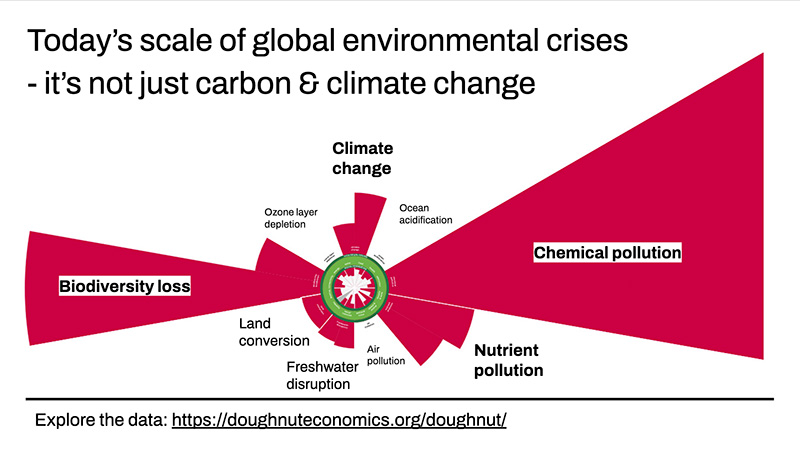
I’ve since become fascinated in framing the right questions – how hard can we push, how many layers of the onion can we peel back to push the overton window? My work on the Wayfinder programme within the NHS has explored the real carbon impact of digital health services, and on digital climate risk has explored how to make digital part of the climate resilience solution rather than part of the problem.
It is this vein of inquiry that led to the collaboration with Green Web Foundation that has been a fantastic discovery into how we can broaden the lens on digital sustainability. This project has given us the opportunity to ask so many wonderful questions:
- What are the key planetary boundaries we must consider?
- How can we leverage the doughnut to link from environmental to social sustainability?
- What are we missing with carbon tunnel vision when it comes to understanding the real impact of digitisation?
- How can digitisation go on to impact the NHS’s key system metric – that of population health in the UK?
- What does this new lens enable in terms of engaging new stakeholder groups and prioritising action?
A rich enquiry indeed – this discovery has opened the door on something that could centralise digital sustainability into a key decision making factor for our health leaders.
What we found
Green Web Foundation and researcher Alistair Alexander collaborated with NHS England’s Greener Digital function, led by Ben Tongue, to explore the following question:
How would our use of digital technologies change if we could quantify the harm to UK health and the additional burden on the NHS they create?
In a general context, which we expand upon in more depth in our first post in this series – Why human health should be digital sustainability’s default metric – we concluded that:
- Advocating for digital sustainability action has more chances of landing if it’s framed in a human-centric way, like through the language of human health impacts.
- Digital carbon emissions estimates are still needed, but can become more impactful if translated into health metrics, like QALYs or DALYs.
- Other environmental impact metrics like water, biodiversity, critical minerals and land use, could also be translated into QALYs or DALYs allowing for more comparison between environmental impacts.
Getting deeper into the project, we posed a follow-on question for the NHS in particular:
How can we start assessing if digital projects can be truly positive to both the environment & human health?
For the NHS specifically, we recommend they:
- Commission further research to develop a robust and evidence-based evaluation framework that translates environmental impacts into health metrics that could be applied to all publicly funded digital health projects.
- Conduct net-positive assessments for digital projects considering the negative health impacts from digital’s use as well as the positives.
- Shift to a more comprehensive default view of digital’s life cycle, considering the material and disposal phases as standard alongside the use phase.
- Use the NHS’ leverage as one of the biggest cloud customers to encourage cloud providers to offer more transparent data on the environmental impacts metrics – water, land use, biodiversity, critical minerals – and to offer them to other public sector and private sector customers.
We accompany these findings with a summary slide deck for the NHS.
How we arrived at these conclusions
Between November 2025 and April 2026, we ran two workshops with a diverse range of NHS staff, engaging participants before and after the workshops, and a hefty amount of desk-based research in the wider field.
Our aim for these workshops was to explore how we can broaden the NHS’s view of sustainability to include the environmental and social costs of digital services, as well as their benefits.
This approach aligns closely with goals described in the upcoming UK Government Digital Sustainability Strategy (2025 – 2030):
- Beyond carbon – understanding our wider planetary impacts
- Addressing social risks and maximising social value
Here’s the current 2020-2025 UK strategy that will be refreshed soon for the 2025 – 2030 period.
Our starting point built on a previous project that applied the Doughnut Economic Model to digital technologies: DoingTheDoughnut.tech which Hannah and Alistair worked on together in 2022. We talk more about this starting point in our first post in this series – Why human health should be digital sustainability’s default metric.
As this was a short project, we focused on health as one of the 12 key social foundations in the Doughnut Model, which is especially relevant to the NHS.
Developing illustrative examples
We saw consistently from our pre-workshop interviews with attendees that it’s generally unclear how the use of digital technologies link to the environment and impact health. For most the relationship between these three things was mainly a positive association, seeing digital as reducing paper use or cutting down travel to in person appointments. A big part of the negative impacts were not present in people’s minds and were not being factored in to assessments.
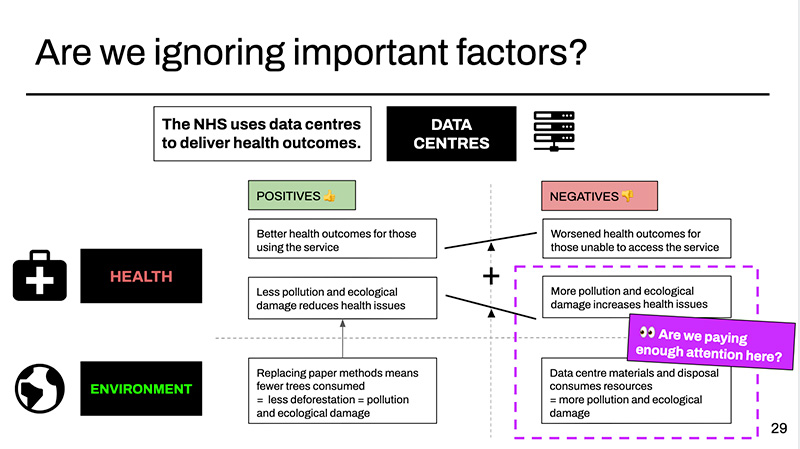
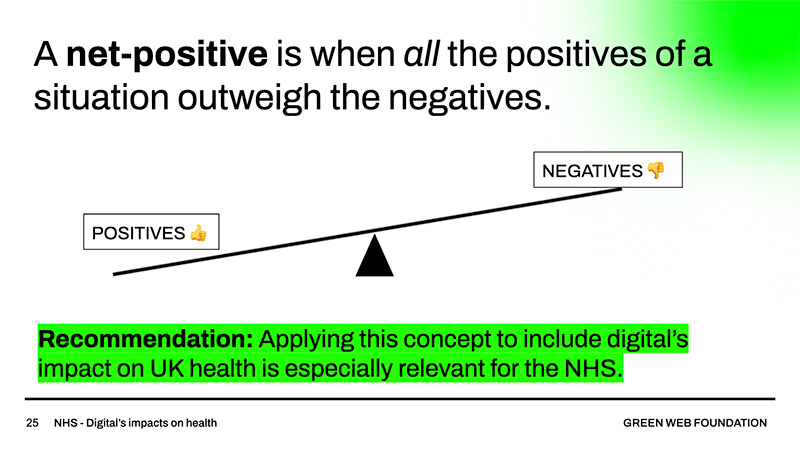
We realised that finding a way to frame all the necessary considerations was needed. We called the high-level approach that resulted as net-positive assessments (hat tip to Claire Robinson at Transform for some her thinking around net-positive from 2024).
Therefore with the help of Christian Evans, BSC Geography student at Leeds University, we identified three illustrative examples designed to highlight the some of the overlooked relationships between digital technologies, the environment and human health:
- Increased electricity use leading to bad diets as a result of climate change
- Growth in data centres leading to more mining causing health impacts
- Data centre cooling using PFAS chemicals leading to fertility issues
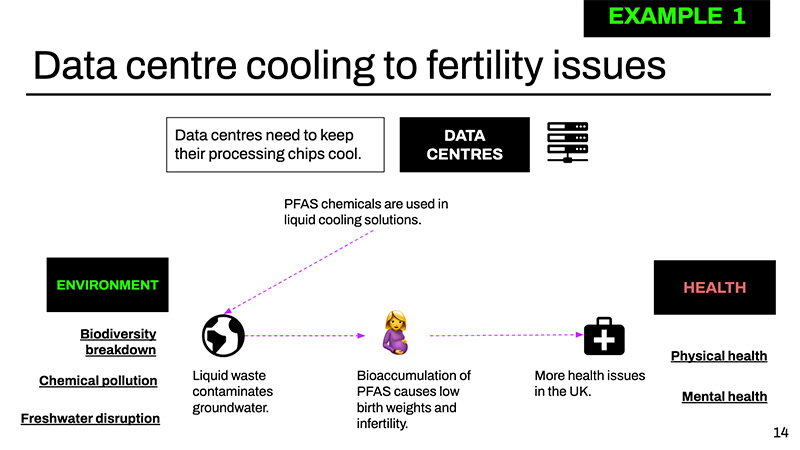
Of course there are many other possible examples, but we felt these effectively highlighted the direct link between digital services and UK citizens’ health. You can see these examples illustrated in our project summary slidedeck.
What we uncovered through trying to find these examples is the research in this field is nascent, with much of it orginating in the US. Here’s a zotero library with all the relevant research we could find. If you know of something we missed, get in touch!
In summary
Our recommendations for the NHS to avoid unintended consequences of NHS digitisation are:
- Commission further research to develop a robust and evidence-based evaluation framework that translates environmental impacts into health metrics that could be applied to all publicly funded digital health projects.
- Conduct net-positive assessments for digital projects considering the negative health impacts from digital’s use as well as the positives.
- Shift to a more comprehensive default view of digital’s life cycle, considering the material and disposal phases as standard alongside the use phase.
- Use the NHS’ leverage as one of the biggest cloud customers to encourage cloud providers to offer more transparent data on the environmental impacts metrics – water, land use, biodiversity, critical minerals – and to offer them to other public sector and private sector customers.
If you’re keen to collaborate to bring this movement to life through research, practical ideas or funding opportunities, we’d love to connect – drop us a line.
Acknowledgements
Christian Evans, BSC Geography student at Leeds University for his research as he contributed to this project as part of a work placement module.
Many thanks to the scholars at the SHADE Research Hub, Kings College London for sharing their archive of resources around what academic research exists drawing a link between digital’s impact on the environment and to health.
Many thanks to the Social Value Team at Accenture who helped us identify a group of very experienced digital practitioners to work alongside inside the NHS.
Eric Zie of GoCodeGreen/Cranda Digital for advice on quantifying the environmental impacts of digital in health, water, and nature metrics.