With partners Ben Tongue from NHS England and Alistair Alexander, we’ve been exploring how digital sustainability can be framed as a holistic problem core to the NHS and in need of more urgent attention. (For those outside the UK, the NHS is the UK’s publicly funded National Health Service, and one of the largest employers in the world.) In this blog, part one of two on the topic, Hannah Smith, our Director of Operations, explains how we arrived at framing the environmental impacts of digital using the metric of human health as an essential path forward, and why those working on the environmental impacts of digital should get on board.
Post summary – the TL;DR
We’re calling upon the digital sustainability community to make our field more impactful by framing digital sustainability in human health terms. We think that:
- Advocating for digital sustainability action has more chances of landing if it’s framed in a human-centric way, like through the language of human health impacts.
- Digital carbon emissions estimates are still needed, but can become more impactful if translated into health metrics, like Quality-adjusted Life Years or Disability-adjusted Life Years (QALYs and DALYs).
- Other environmental impact metrics like water, biodiversity and land use, could also be translated into QALYs or DALYs allowing for more comparison between environmental impacts.
If you’re keen to collaborate to bring this movement to life through research, practical ideas or funding opportunities, we’d love to connect – drop us a line.
Stitching humans back into the environment’s story
“Traditional” environmentalism is generally acknowledged as a failed approach because of one common problem: overlooking the fact that humans are actually an intrinsic part of the natural world and not separate from it.
This approach, sometimes called environmental purism, pushes for protecting nature for nature’s sake or to “restore” pristine environments without human presence. Often regarded as the realm of out of touch, affluent elites, traditional environmentalism lacks an inclusive approach and removes humans out of the environment’s story.
Which means for many people, calls to protect the environment sound like a binary choice: it’s humans or the planet.
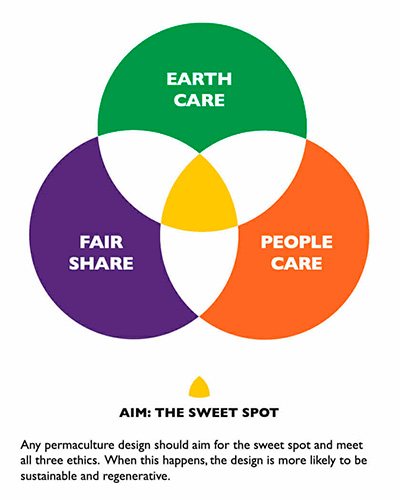
I admit, I fell foul of this binary thinking in my younger years too, being more inclined to think of the environment as the priority over people. Doing a permaculture course exposed me to much broader thinking: “Earth care, people care and fair share” is the central permaculture motto and sets out that we shouldn’t see ourselves in competition with nature. We can design our society and systems so every thing balances and we’re all prosperous.
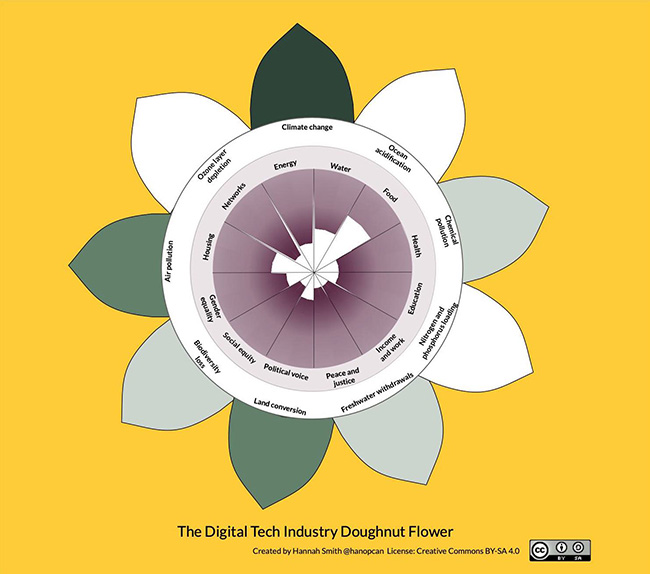
The digital tech industry doughnut flower – https://doingthedoughnut.com
This realisation further deepened for me through Doughnut Economics. There I met the doughnut, a visual concept of a safe space between nine planetary boundaries and twelve social foundations in which humanity can thrive. I find it a beautifully useful tool to understand what a holistic approach to sustainability is. For my Green Web Fellowship, I applied the doughnut’s concepts to exploring digital tech’s impacts on the environment and society, and created DoingTheDoughnut.tech with awesome collaborator Alistair Alexander.
These kinds of approaches share a similar narrative – environmental action means a better future for humans, especially when humans are understood to be intrinsically linked to the environment.
I’d argue this notion is equally applicable within digital sustainability circles, and one where we have some room for growth. We’ll struggle to land impact that sticks if our stories don’t position people in the pathways to, and beneficiaries of, a more sustainable digital tech industry. Arguments about the importance of digital sustainability to reduce carbon, be more sustainable or protect nature only land effectively with a select few.
But frame and measure our concerns around something uniquely human like our health? Then we might have a game changing narrative that has the potential to resonate better.
Innovating with the NHS
It was DoingTheDoughnut.tech that got myself and Alistair in touch with Ben Tongue, bouncing around ideas together such as:
- Could we use a similar approach inside the NHS to inspire a deeper commitment to digital sustainability, moving beyond simply setting out to make tech run more efficiently in a carbon tunnel vision?
- What consideration of the holistic impacts of digital on the world around us, both human and more-than-human, would such an approach generate?
- Could this guide decision makers at different levels inside the NHS to identify what functionality is sufficient to meet the needs of users, and leave a sustainable planet for those following behind?
Yes, blimey, BIG and juicy questions!
From the outset, we couldn’t miss that health is one of the doughnut’s twelve social foundations. And of course health is the key metric that the NHS is designed around serving.
So how could we play this to become an advantage? How might we talk about digital sustainability, specifically the environmental harms arising from digital, in terms that the NHS is already primed to act on, that is the language of human health? How can we shift the narrative to be one that helps people connect the dots – that if tech harms the environment, it by extension also harms us humans?
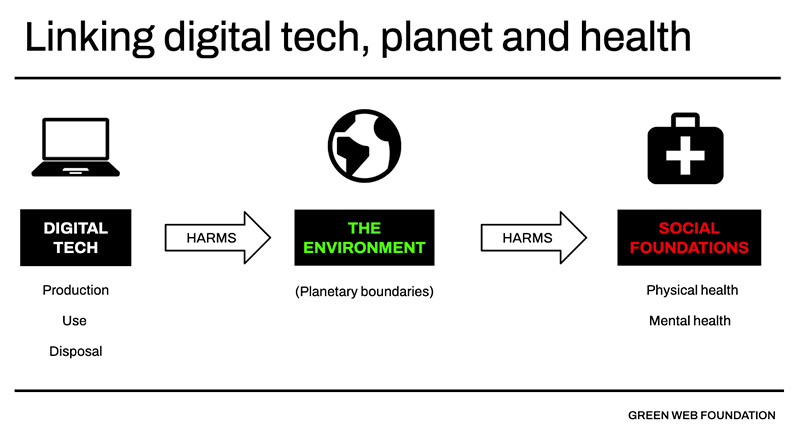
Let’s also not forget that the NHS is in crisis mode, under pressure from a lack of funding and worsening health amongst its population. The topic of digital sustainability is one that can be easily dismissed as a nice to have, and resources prioritised elsewhere. But what if the NHS’s 10 year strategy to digitise all the things actually harms human health through increased environmental impacts and creates additional burdens on its health services?
We do a deep-dive into how we could get started with this approach in the NHS in our second post on this topic – From carbon to care: avoiding the unintended consequences of NHS digitisation. For the remainder of this post, we’ll continue in a more general context.
Framing digital tech’s environmental impacts in a more human way
Going back to the opening of this post, we know that being able to frame sustainability conversations in human-centered ways is more likely to garner wider support and get acted on.
One single conversation at GreenIO Paris 2024 in this vein really stuck with me: I heard a very passionate view that framing the environmental impacts of digital in human health terms was a far more impactful way of getting those in government to change policy, because ultimately this resonated better with voters. (I’m hugely embarrassed to not recall the name or organisation of the other person. If that was you, thank you for the wisdom!).
They were spot on.
Local data centre impacts
We’re starting to see this exact thing play out across the UK as more local communities feel impacted by data centre expansion plans.
The pushback is fierce because those living around data centres see immediately how the environmental harms translate directly to worsened health for them and their loved ones. Be it through air pollution, water shortages, increased noise and light pollution or PFAS chemicals (known as forever chemicals). The UK government has a parliamentary enquiry into the environmental impacts of data centres in relation to net-zero targets, which is a good step forward.
Of course it’s not just the UK where there is growing local opposition to data centres. Data centre expansion is accelerating globally and communities in other parts of the world are also pushing back.
In particular, communities in the US are much further ahead in feeling the pain from data centre expansion because of the concentration of data centres in certain states. There’s a growing body of academic research coming from there framing data centre harms in terms of human health – we can learn a lot. Here’s a zotero library with all the relevant research we could find. If you know of something we missed, get in touch!
Global supply chain impacts
There are environmental, and therefore health impacts, at a global level too.
The production of all the technology that goes into data centres and devices requires mining for resources. Mining results in severe environmental harm and health impacts – there’s no such thing as sustainable mining. Silicon chip manufacturing uses vast amounts of pure water and electricity. Even the concrete needed to build enormous data centre campuses is responsible for a surprising amount of carbon emissions.
As we discussed in our State of the Fossil-Free Internet report, even before fossil fuels are burned, the process of extracting them from the earth is one of the most unjust and harmful practices on the planet. Globally, we get just under two-thirds of our electricity from fossil-fuel sources. Regardless of the origin of emissions, everybody suffers from the harms they cause – meaning data centre operators are inflicting harm far beyond their immediate footprint.
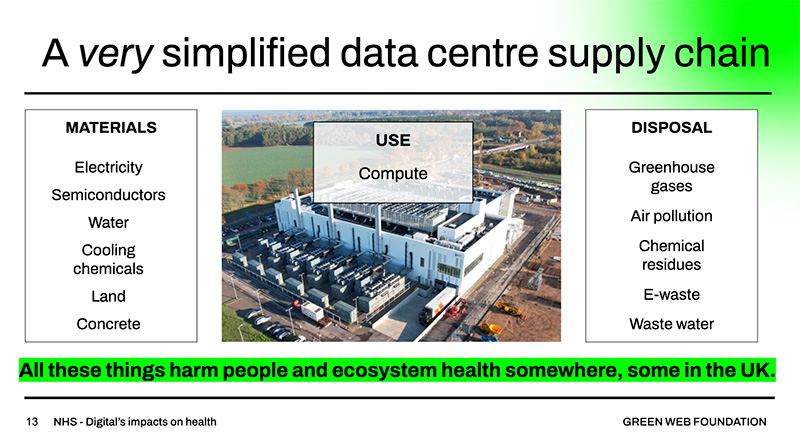
All these harms need taking into account when we ask if digitising something is worth it – and they rarely are.
The final part of this post goes on to show how we can build on existing practices within the digital sustainability field to start bringing health more consistently into the picture.
What gets measured, gets managed
Carbon emissions
The status quo in the digital sustainability field is that carbon emissions are the de facto metric used to describe the environmental impacts of building and running tech. It does stand to reason that this is where the journey of our relatively young field started.
For most, electricity is the most tangible resource needed by digital. Chances are you have several devices of your own – laptops, phones, TVs – that need to be plugged in to function. If you’re concerned about climate change, you’ll know the burning of fossil fuels for energy is the primary cause. Digital technologies consume a fair amount of electricity and cause significant environmental impacts.This has led to the development of estimating digital emissions as a burgeoning sector.
The problem with using carbon emissions as a key metric is that it doesn’t relate to humans all that well. What does 20kg of CO2 emissions mean in practical terms? It’s not a human-centric framing for most.
Our next leap is to connect those carbon emission estimates to human health impacts.
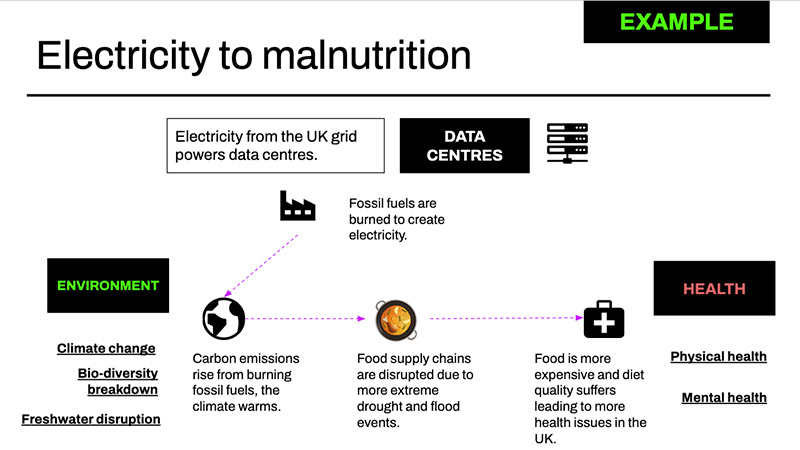
It might sound daunting, but the good news is there’s already a lot of well thought through methodologies out there doing this in other contexts, and health metrics like Quality-adjusted Life Years (QALYs) or Disability-adjusted Life Years (QALYs and DALYs). QALYs and DALYs have been used in public health policy for decades to put impacts into comparable numbers.
Quick primer on QALYs and DALYs. Health interventions undergo cost-effectiveness analysis to measure the impact on both the length and the quality of life. QALYs (Quality-Adjusted Life Year) and DALYs (Disability-Adjusted Life Year) are common terms used within this framework. QALYs are a measure of years lived in perfect health whereas DALYs are a measure of years in perfect health lost. They are the most frequently cited metrics for risk-benefit assessment. More on QALYs and DALYs.
That said, we found only a handful of examples of the full chain of connections (digital technologies to environmental harm to health impacts) being applied to real world digital tech scenarios yet – mostly data centre harm in the US – and certainly nothing that covered the full life cycle or felt “production-ready”. Here’s a zotero library with all the relevant research we could find. If you know of something we missed, get in touch!
This is an area ripe for progress in our field. With the help of academics, digital practitioners, civil society and the wider community it’s entirely possible we can find ways to link up the whole chain – digitisation to environmental impact to health outcome – and move the field of digital sustainability towards greater impact.
Moving beyond carbon
Whilst carbon might be the most common metric, it’s not the only one. We’re seeing other natural resources consumed by tech step into the spotlight as mentioned earlier. Water in particular. Much of the data centre resistance activism at the local level is propelled by concerns over water usage. Data centre operators in the EU are now being mandated to report on WUE (water usage effectiveness) as a key metric. Our emerging Digital Impacts Schema and Taxonomy project hopes to tackle water.
Whilst the metric of water usage hasn’t reached the maturity of digital carbon emissions estimates, it’s getting there. It doesn’t feel like it will be long before we’re reporting on both as standard.
And what about other environmental metrics?
Air pollution is also coming up a lot more, especially as the AI boom is driving an increase in new facilities being powered by on-site gas turbines and digital generally requiring growing amounts of electricity. We need a metric for that too, no? PFAS chemicals (known as forever chemicals) is another one getting more attention, especially as data centre operators try to optimise for more energy efficiency and turn towards different cooling techniques. And a metric for that too? And then we have the mining of critical minerals needed for all the complex tech inside our data centres and tech. Those processes all have consequences for land use, biodiversity and also water. One for each of those too?
You can see where this is going – all these important environmental impacts need visibility, but they quickly add up to become an overwhelming number of not very comparable metrics.
If we can’t compare all these different impacts (both positive and negative), getting to a point of understanding if all this investment in digital services is truly net-positive is less likely.
My colleague Katrin Fritsch has written a great piece exploring this dichotomy in the world of AI.
We think using existing research to translate the environmental impacts of tech into a human health metric, like QALYs or DALYs can perform that role for us.
In summary
Rounding this post off, our key points are:
- We are calling upon the wider digital sustainability community to work together to deepen the approaches to framing digital sustainability in health terms to make our field more impactful.
- Advocating for digital sustainability action has more chances of landing if it’s framed in a human-centric way, like through the language of human health impacts.
- Digital carbon emissions estimates are still needed, but can become more impactful if translated into health metrics, like QALYs or DALYs.
- Other environmental impact metrics like water could also be translated into health metrics allowing for more comparison between environmental impacts, laying the groundwork for investigating if developing digital services to drive health outcomes is net-positive or not.
If you’re keen to collaborate to bring this movement to life through research, practical ideas or funding opportunities, we’d love to connect – drop us a line.
Next up
See part two of this series where we get more into this in the context of the NHS – From carbon to care: avoiding the unintended consequences of NHS digitisation.
Acknowledgements
Christian Evans, BSC Geography student at Leeds University for his research as he contributed to this project as part of a work placement module.
Many thanks to the scholars at the SHADE Research Hub, Kings College London for sharing their archive of resources around what academic research exists drawing a link between digital’s impact on the environment and to health.
Many thanks to the Social Value Team at Accenture who helped us identify a group of very experienced digital practitioners to work alongside inside the NHS.
Eric Zie of GoCodeGreen/Cranda Digital for advice on quantifying the environmental impacts of digital in health, water, and nature metrics.