You might have come across the following statement that “AI might use a lot of power, but it’s also good for the climate, so it’s a net benefit.” Together with number of civil society organisations we commissioned climate analyst and researcher Ketan Joshi to explore these industry claims. In this post, Director of Strategy Michelle Thorne gives the lowdown about why it was written and its key findings.
First critical analysis of industry’s statements on AI and climate impact
We often hear the tech industry making claims about the climate benefits of artificial intelligence (AI), and these claims are often used to justify the build out of immense amounts of new digital infrastructure such as data centres, which themselves rely on unprecedented amounts of fossil fuel power generation. If you care about a fossil free internet, this is the opposite of what you would want to see, particularly if the benefits offered are unclear and unproven.
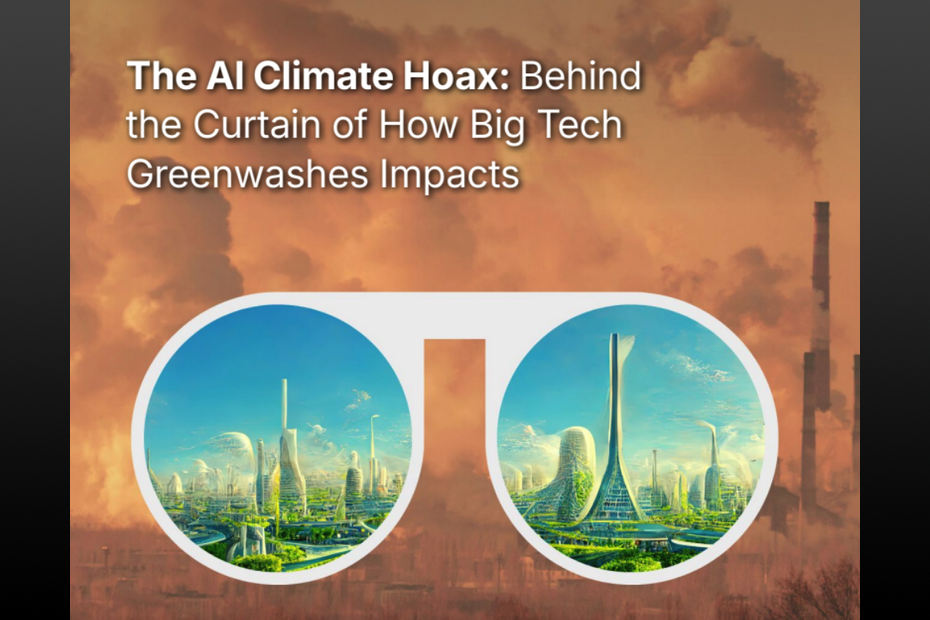
A key finding from new report The AI Climate Hoax: Behind the Curtain of How Big Tech Greenwashes Impacts raises clear questions about these benefits. It shows a staggering 74% of claims in 8 of the most commonly cited sources about AI’s climate benefits are unproven, serving the profits of tech and fossil fuel industries, while downplaying the major climate harms of generative AI.
The research looks at 154 statements claiming AI will serve as a net climate benefit – including from companies like Google and Microsoft, and from institutions such as the International Energy Agency – and, for the first time, critically analysed the assertion that AI will be a net benefit to climate action, making up for the increased fossil fuel demand by AI-driven data centres.
According to the findings, only 26% of the claims cited published academic papers and 36% did not cite any evidence at all. Overall, these claims tend to rely on weak forms of evidence rather than robust, peer-reviewed academic papers.
The report was commissioned and published by a consortium of environmental organisations including Beyond Fossil Fuels, Climate Action Against Disinformation (CAAD), Friends of the Earth U.S., Green Screen Coalition, Green Web Foundation, and Stand.earth, and was authored by climate and energy analyst Ketan Joshi. It was released ahead of the AI Impact Summit 2026 (19-20 February, New Delhi, India).
Tactical Vagueness
The study examines the types of AI underpinning these claims and the strength of the evidence put forth alongside them. The analysis did not uncover a single example where consumer generative systems such as ChatGPT, Gemini, or Copilot were leading to a material, verifiable, and substantial level of emissions reductions. It finds that claims about “AI sustainability” blur the differences between generative AI – which carries major environmental costs, with the much lower energy and environmental footprint of “traditional” AI, used for instance for machine learning to forecast wind patterns. This deceptive bait-and-switch is a new form of greenwashing used by the tech industry.
“It appears tech companies are using vagueness about what happens within energy-hogging data centres to greenwash a planet-wrecking expansion. This has bled through into organisations like the International Energy Agency. The promises of planet-saving tech remain hollow, while AI data centres breathe life into coal and gas every day. These claims of climate benefit are unjustified and overhyped, and could cover up irreversible damage being done to communities and society.”
– Ketan Joshi, Independent climate and energy analyst
In short, the evidence that AI will lead to large-scale climate benefits is weak, whilst the evidence of immediate and substantial climate and environmental harm is strong.
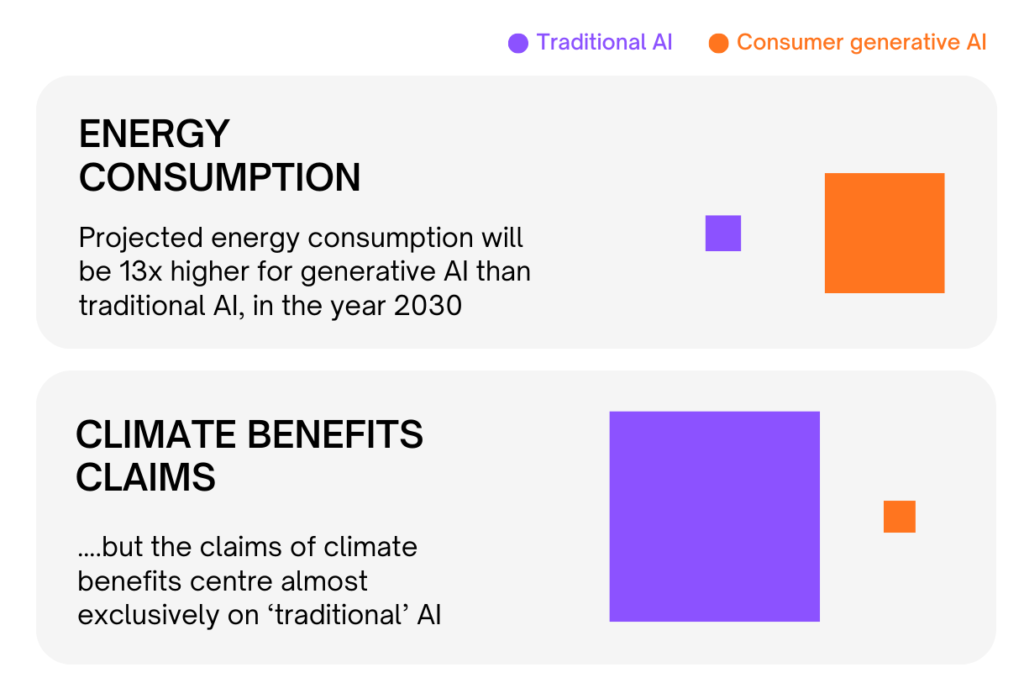
Exaggerating AI’s climate potential distracts from the real costs of massive, energy- and water-hungry data centres imposed on communities worldwide. What’s more, we see companies veering wildly away from their climate targets whether you use their metrics that incorporate renewable energy deals or not.
“Big Tech’s AI hype is distracting users from the rapid and dangerous expansion of giant, energy and water-intensive data centres, while the tech industry’s huge energy demands are throwing the fossil fuel industry a lifeline. There is simply no evidence that AI will help the climate more than it will harm it. Rather than relying on credible and substantiated data, Big Tech companies are writing themselves a blank cheque to pollute on the empty promise of future salvation. We cannot bet the climate on these baseless claims.”
– Jill McArdle, International Corporate Campaigner, Beyond Fossil Fuels
The accelerated growth of AI is increasing pressure on the climate, and Big Tech must take responsibility for mitigating its environmental impacts. Companies must disclose their energy consumption and emissions, and be transparent about the environmental and social justice impacts of their technologies, and whether data centres are really serving the critical needs of society.
“Any climate benefits are far outweighed by how much energy generative AI is using. By lumping traditional and generative AI together, possible climate solutions are bundled with extreme pollution, and presented as a package deal. Governments must require basic transparency from the AI industry so communities and scientists can know how much energy is being exploited for this technology.”
– Michael Khoo, Policy co-chair, Climate Action Against Disinformation, Program Director, Friends of the Earth U.S.
Video and social
Ketan produced two great videos unpacking this report.
- 3 minute overview: AI vague-washing (watch on Youtube)
- 3 minute overview: Weak evidence for benefit, strong evidence of harm (watch on Youtube)
MEDIA Coverage
Check out further coverage of this report in: The Guardian, Deutsche Welle, WIRED, De Coorespondent (Dutch), CNN (Portuguese), France Inter (French), Politico, Mother Jones and more.
____________________________
NOTES: METHODOLOGY
The analysis searched for prominent claims of a net benefit of the deployment of AI towards the project of climate action, using searches. Major reports, such as the International Energy Agency’s “Energy and AI” report, along with sustainability reports from Microsoft and Google, and several published papers were included in the analysis. Each claim was coded for the type of AI referenced and the type of evidence presented to buttress the claim. These were collated and presented according to the coding results. Generative AI was not knowingly used in any part of the production of this report.