Over the last year, we’ve been covering a landmark law in Europe, the Energy Efficiency Directive, that if implemented as described, and enforced effectively, would be transformational in terms of transparency in the sector. It required disclosure at a datacentre level the kinds of information that we and others have been calling for for years – things like how ‘green’ the energy was, how much water is being used, how efficient facilities are, and so on. This year, as part of a new package of laws relating to datacentres, a set of minimum performance standards for datacentres are being introduced, based partly on data from this EED law. Yesterday was the first stakeholder workshop, and in this post, our director of technology and policy Chris Adams shares what we learned.
As mentioned, this first stakeholder workshop happened yesterday on March 24th, and it’s best to think of this post as a summary of what was shared as the process to define minimum performance standards within Europe.
As such, while we’ll add some commentary in this post, the goal is conveying some of the key points from the 3 hour workshop and what they might mean for folks who care about a fossil free internet. There will be further information coming, but it looks like it may be hosted on the European Commission’s special working group platform, CircaBC. Until the slides are available, you can see all the screenshots of the slides presented on this shared folder uploaded yesterday.
Understanding the current context
To understand how we got here, this draft of a problem tree below presented yesterday in the workshop gives a good idea of how the people managing the minimum performance standards process see things right now.
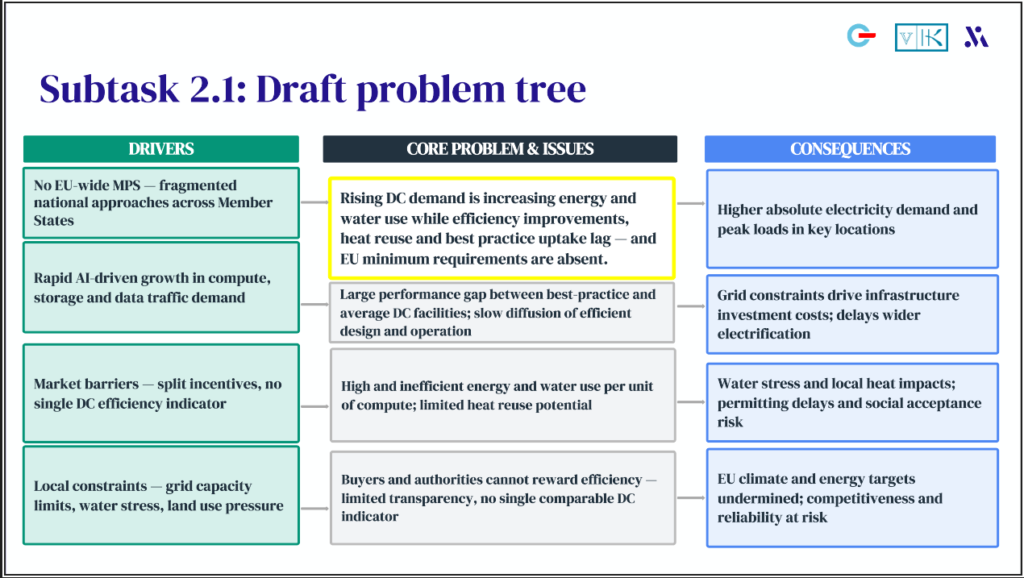
We have a massive amount of AI-driven growth in demand for digital resources (i.e computation, storage, transfer), but a very fragmented approach when it comes to describing what ‘good’ looks like for both new and existing datacentres. Even where there are efficiency improvements that might offset a growth in demand, they occur very unevenly.
As a result, when we look at the consequences we see a number of bad things:
- heightened water stress in various areas
- significant jumps in electricity demand (which is not yet fossil-free, meaning more carbon pollution)
- a bunch of equity issues like the cost of all these datacentres being socialised in electricity grid network upgrades
- competition over access to power between datacentres and other sectors trying to get off fossil fuels through electrification
- trashed environmental and climate targets
- a more dysfunctional datacentre sector where pockets of waste and inefficiencies remain
- and lower social acceptance of datacentres by the rest of society (if you run a datacentre, this bad news for you, as it effectively is your social license to operate)
We need to state this is a draft problem tree, and it doesn’t pretend to be comprehensive, and it’ll likely evolve, but to be honest, this covers a lot of ground if you’re new to the topic.
Green Web take: From the Green Web perspective, if you see us talking about absolute demand instead of just efficiency, or just clean power and wonder why, this is why – even in ‘official’, industry-friendly events like this, it’s literally front and center in the discussion, and it can no longer be avoided.
There will be new performance standards, and they will affect both new and existing datacentres
Late last year, when we were tracking this topic, it wasn’t clear that we would even end up with minimum required standards at all. Instead, there was talk of there merely being a labelling system, and just letting the market sort it out.
However, this first workshop gave the impression that no, there will actually be a bar everyone has to clear, but it might not be the same for everyone, and there is a very clear link back to the original EED laws we have been writing about at length.
On the face of it, this makes some sense, because there are significant differences between the size and resources available to organisations that operate facilities at different ends of the spectrum.
To make this concrete, the lower end of datacentres covered by laws like the EED are 500 KW datacentres. When we look at just inside Europe at the upper end, we can see projects like the Start Campus in Portugal, which is more than two thousand times larger, at around 1.2 Gigawatts in expected capacity when completed.
That said, this doesn’t mean that 500KW facilities are tiny. Someone operating a 500KW datacentre facility, if you assume typical industrial electricity rates for Europe, is likely spending at least 400k EUR on electricity, and probably more like North of a million EUR per year in most parts of Europe on power.
Green Web take: Having actual minimum standards is definitely a step forward compared to a labelling system. While transparency is definitely helpful, and a prerequisite for sensible policy making, we’ve learned in other sectors that when they are entirely voluntary, they often get dropped as soon as it’s no longer convenient to conform to them.
Having it apply across the board is interesting too. It’s important because when people talk about smaller players in the datacentre industry, it’s easy to assume people are talking about a single ‘ma and pa’ business, or a rack of servers in a broom cupboard somewhere – this isn’t really the case. It’s not that the small datacentres are that small, it’s more that the big ones are now really big.
From a diverse tech industry perspective, this likely has implications for the lower end as much as the higher end, because there is a fairly long tail of smaller datacentres who might need to invest in changes to how they run, and broadly speaking they don’t have the same access to capital as the bigger players. If they can’t borrow the money to pay for changes, we might see them close down, leading to more consolidation among already very large players, who are easily large enough to distort the market, and have massive budgets for lobbying, which has been covered at length by groups like SOMO.
The timeline to develop these standards is aggressive
One other key takeaway was the expected speed of the process. The stated intention was to have this process and a proposal submitted and adopted by policy makers by either the end of this year, or maybe early next year.
You can see below the assumed timeline for both these workshops and research that would happen as a prelude to there being a concrete proposal submitted to policy makers, to vote on.
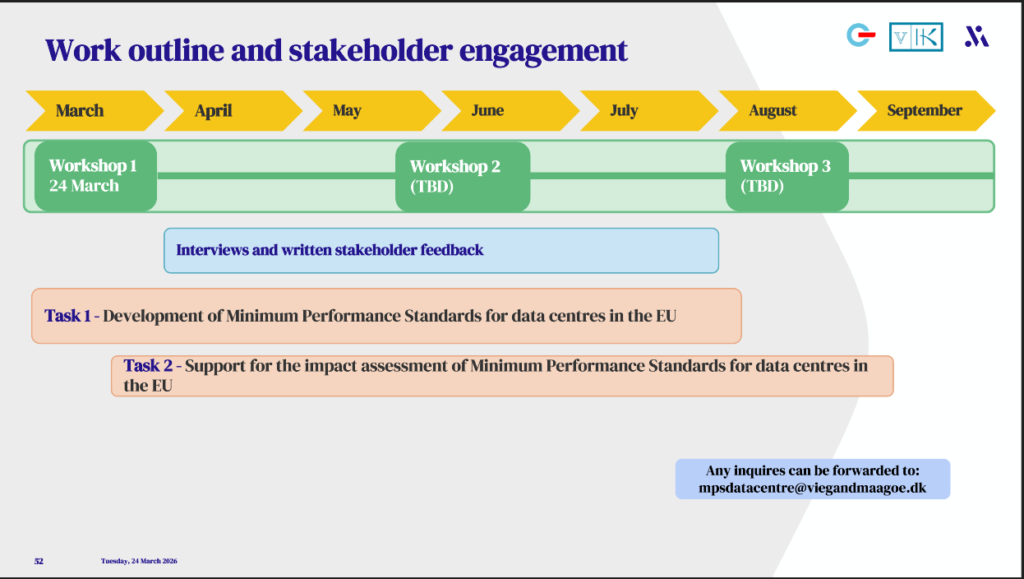
Green Web Take: In regulatory terms, this is speedy. By comparison, changes to the EED to being applying to datacentres started a while before July 2021, when it was first proposed, and we only saw it officially accepted (‘adopted’ in EU speak) two years later in March 2023.
While there is now more to build on, this timeframe of between nine and say… fifteen months is around twice as fast as before.
The impacts of the changes will be modelled in different scenarios to inform the policy making
This is all well and good, but what are these minimum performance standards expected to be based on? What kind of evidence is actually shaping this? This was covered as well, and this slide is graphically represents how they think it will be modelled. You can see time above dedicated to interviews and stakeholder feedback:
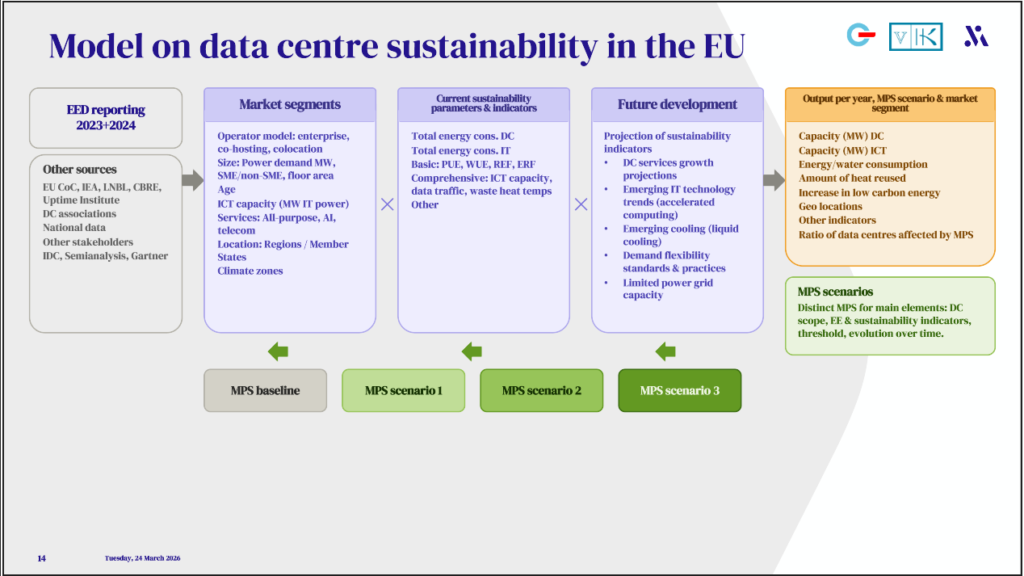
What do we see here?
Unsurprisingly the EED reporting evidence base for the last two years will be used, but that’s not the only source. In addition to various interviews and research, a few other sources of info are listed here too.
There was also some time dedicated to how the minimum bar to clear might look different, depending on things like how big a datacentre was, where it was in Europe, how old it was, and so on.
Cruciallym on the slide you see both indicators that refer to data-points that have already been accepted in industry for a long while, but also space dedicated to reference new ones that have become much more salient in the 2020s, like flexibility, local grid capacity, and so on.
While it wasn’t on the slide there was a fair amount of discussion about how energy counts as ‘green’ right now, with references to annual clean energy loopholes, and onsite fossil gas generation.
Green Web take: A quick note about the annual loophole. We’ve covered this in other posts, but one thing we’ve seen already in the EED data so far is that most claims to run on green power appear to be based on ‘unbundled’ certificates.
These are typically purchased separately from power from other countries, as an alternative to making investments in clean energy on the same grid, which would ideally displace current generation from fossil fuels. For a region with an explicit target for climate neutral datacentres by 2030, this matters, and having it acknowledged in this session was welcome.
The use of different scenarios to help understand the impacts of different standards is welcome too, and we’re hoping these will be open, transparent and reproducible. There are now examples of this in the public domain, using open data and open source code that allow independent reproduction.
Companies like Form Energy now share open models of how their iron-air batteries can replace gas in Germany, using actual weather data and grid demand data right down to the substation level. Other researchers have used similar approaches to show that getting fossil fuels off the grid by 2030 is both plausible and desirable, using the same modelling tools by large tech firms themselves. Elsewhere there are now freely available graphical scenario builder solutions that use the same underlying software to let policy makers see different scenarios without needing to be specialist modellers.
The state of the art in 2026 has come along way now, and we have seen how earlier, simpler approaches used in other countries like the UK hasn’t always passed the sniff test, leading to new parliamentary inquiries in that country to shed more light. Given how politically charged discussions about datacentres are in the public sphere are getting, it feels like erring on the side of transparency, for a data-informed discussion is even more critical than it might have been before.
Now what?
The workshop literally happened yesterday, and this is a very abridged writeup of what was covered. As mentioned before we’ve written quite a lot about the EED, and if you read this wanting to see what teh standards might be, we shared an early view of what the actual minimum standards were shaping up to look like in May 2025, shortly after an earlier workshop last year.
This was the first of three workshops this year, and the next one will likely be in May / June, after the next EED day on May 15th, where datacentre operators will be expected to disclose the next set of data across Europe for 2025. With some luck we’ll see a higher uptake than 35% participation rate we saw previously.
We’ll share what we learn like we did with this when that workshop happens, but if you’re interested you can also sign up for notifications yourself on the main EU website for the project.
As ever, if this was interesting to you, you might like our newsletter, or support the work we do, and if you want to collaborate with us on this topic, drop us a line, we’re always happy to chat.