We’re happy to announce the release of carbon.txt v0.4 – an updated version of the carbon.txt syntax, which allows for a more flexible and nuanced description of your sustainability claims. In this post Tim explains what the new functionality is, how it benefits carbon.txt users, and how organisations or individuals can help us shape it as a standardised approach.
What’s carbon.txt?
Firstly a quick recap – carbon.txt is an open-source tool designed to make sustainability data easier to discover and use on the web.
You might have already heard of a robots.txt file. It provides a simple, standardized means for site owners to express how they want search engine bots to crawl their site. Carbon.txt is a similar idea – it provides a single, standard location to share your sustainability reporting and green commitments – in a .txt file using a simple, human and machine-readable format at yourdomain.com/carbon.txt.

Over the past 6 months, with funding from ICANN, we’ve been scoping and expanding carbon.txt’s capabilities to address data transparency and standardisation issues in the field of carbon emissions reporting relating to digital systems and internet infrastructure.
As part of this work, we’ve been adapting our Green Web provider portal (which powers our very popular Green Web Check), in order to allow providers to use carbon.txt files to share their green hosting evidence with us and also improve the accuracy of Green Web Check results. We’ve also been exploring the needs of other organisations, and standards bodies, who are a good fit for adopting carbon.txt to make their own sustainability reporting easier to find and work with.
What’s in v0.4 of the carbon.txt syntax?
This release has focused on evolving carbon.txt to express the nuance of sustainability claims made by organizations, and make accessing relevant, current information easier for downstream users.
In summary, carbon.txt syntax v0.4 delivers the following:
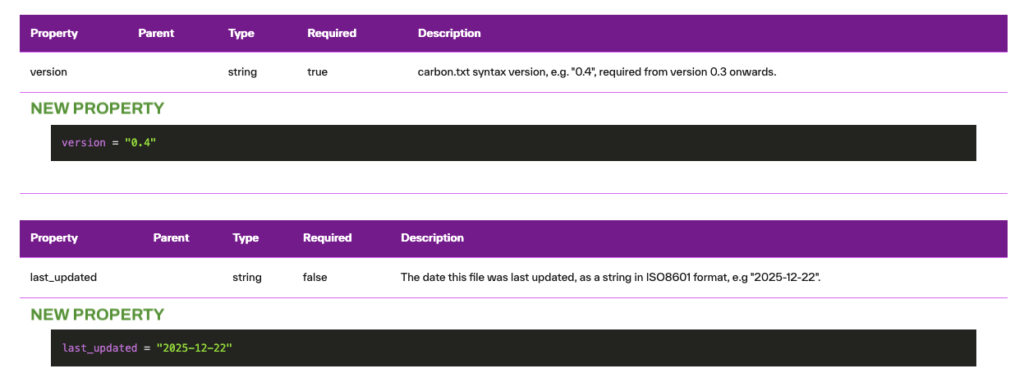
- Files have an optional last_updated property.
- Files have an optional version property, defaulting to v0.2 if not specified.
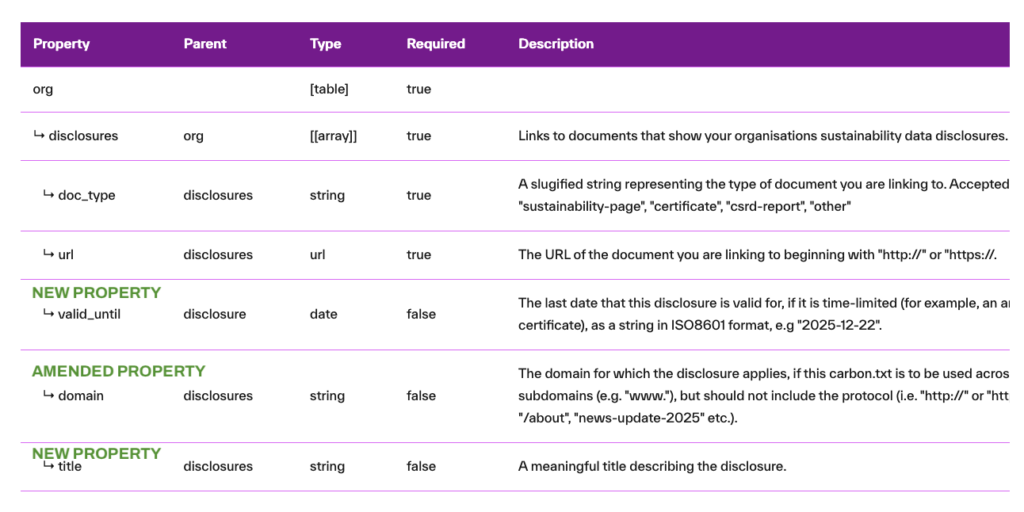
- Each disclosure can have an optional valid_until and title property.
- The domain property on a disclosure is now optional.
All our carbon.txt tools — the validator, builder, and syntax reference — are updated with these new features.
Changes to the disclosures section
The main contents of a carbon.txt file is a set of disclosures — links to published information about a company’s sustainability commitments. Disclosures can be a range of document types such as annual reports, a sustainability policy page, certifications from standards bodies, or mandatory/voluntary standardised reporting data, such as for CSRD, EED or TCS. These are key resources for understanding and verifying the sustainability commitments made by an organization, so it’s important that we model them properly.
As disclosures are often time-sensitive in that they have particular periods of validity, and can expire, we’ve amended the syntax so each disclosure can have an optional valid_until property. This represents the last date on which the disclosure is valid, and allows downstream users to discount disclosures which have expired — for instance, a 2025 annual report could have an end date of 31 December 2025.
We also added an optional title property to disclosures. This is useful for presenting the contents of a carbon.txt file back to users and making it easier to understand. Document titles are usually difficult to parse automatically from the link disclosure, and, besides usually organizations want explicit control over how it is presented. Using the title attribute, you can now explicitly control how this information is presented to users of upstream and downstream services which use the data linked to in your carbon.txt.
One other minor change is the domain property in disclosures in now deprecated. It remains valid, and optional for now, but will be removed in a future version. This field was intended for users who use a single carbon.txt file across multiple properties where different disclosures apply. We now have an alternative delegation mechanism for sharing carbon.txt files across domains, and where the particular disclosures needed vary between domains, the preferred means of expressing this is to just create a different file for each domain that needs its own particular set of disclosures.
General syntax
The carbon.txt file itself has an optional last_updated property, to hold the date the file was last edited. This allows downstream users to understand how fresh the information in the carbon.txt is more generally.
Finally, with all these changes, we required a way of tracking which version of the carbon.txt syntax a particular file was produced against, in order to correctly parse and validate it. As a result, the file now has a version property. This is optional, and will be assumed to be “0.2” – the last version of the syntax without an explicit version number – unless otherwise specified. If you want to use these new features, you will have to explicitly specify version 0.4 in your file so that it can be passed and validated correctly.
Share your feedback and get involved
These changes have come about due to feedback from the community. Special thanks to exortech (Owen at .eco) and mgifford (Mike at Civic Actions).
In 2026, we’ll be expanding our community reach and forming several advisory groups to guide us on the development of tools that interface with carbon.txt to address data transparency and standardisation issues in the field of carbon emissions reporting relating to digital systems and internet infrastructure. Specifically, we have our sights on the Tech Carbon Standard, Energy Efficiency Directive and the Blue Angel Certification.
If you have an interest in sharing your expertise or experience across the above mentioned standards, or have ideas on other standards, do get in touch. Participation in advisory groups can be compensated with a modest financial payment. Reach out to us using our support form.
To stay up to date on carbon.txt’s latest developments consider signing up to our monthly newsletter.